The Natural Wonders of São Miguel

São Miguel Island is the poster child for the Azores. When you see brochures for the Azores, you see a picture of a caldera on San Miguel Island. A caldera is a large, bowl-shaped depression formed by the inner collapse of a volcano’s summit. It’s distinct from a crater, which is a much smaller, depression typically formed by outward explosion of material during an eruption.
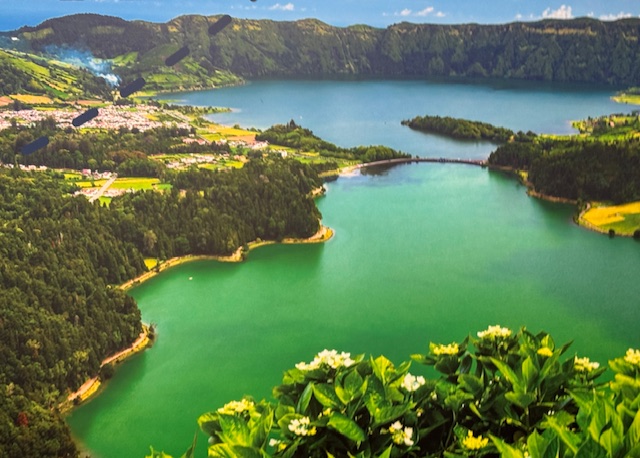
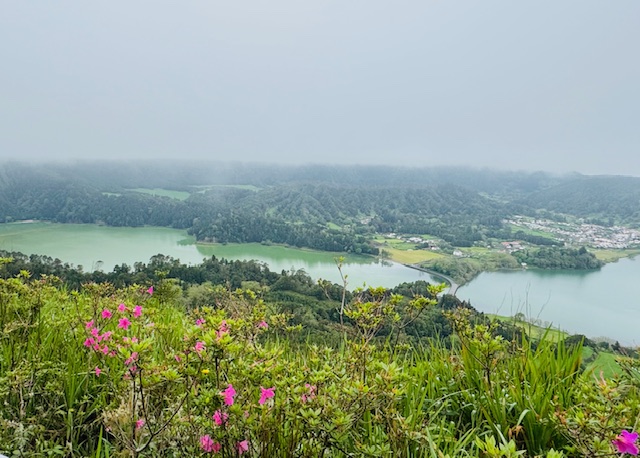
This is photo of a photo in an ad promoting the Azores, taken on Såo Miguel.
This is our photo of the famous caldera the day we saw it…still beautiful even with the cloud cover. photo gb
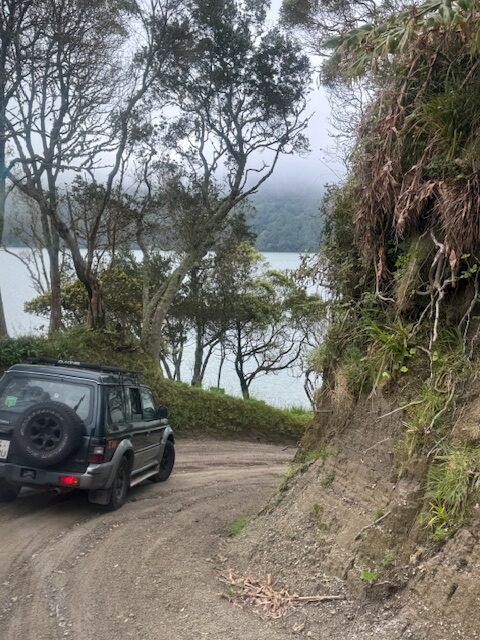
One of the jeeps in our caravan.

For this discovery adventure with OAT, we were divided into small groups, and rode over rough terrain in jeeps to the western part of the island to see this caldera. Although it was overcast, we enjoyed seeing the stunning landscapes along the way.
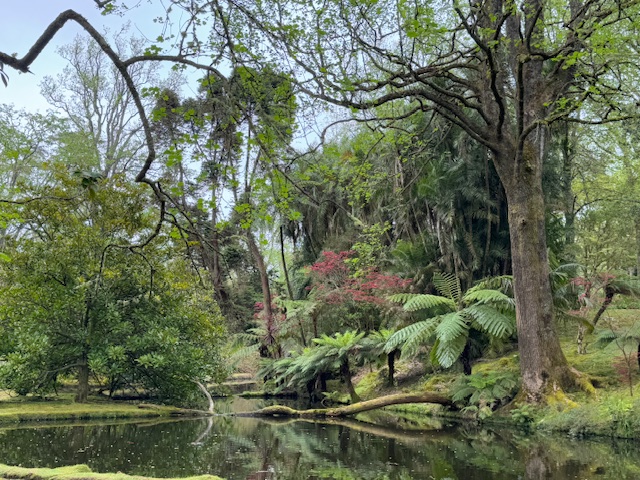
Mata Jardim José do Canto – one of the botanical gardens on São Miguel.

Also, on this island we went to a botanical garden (Mata Jardim José do Canto) with a thermal pool. The hot springs look muddy, but its minerals in the water that make it look that way.
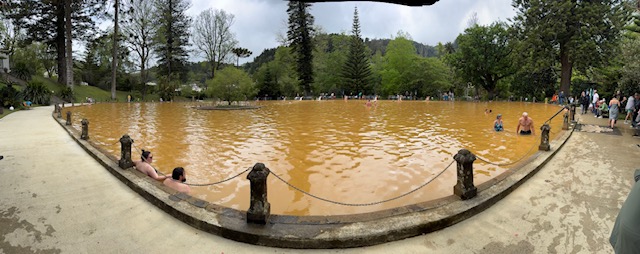
The thermal pool, in the botanical garden. photo gb

We were told to bring an old swimsuit since they would get stained from the water. It felt good to be in the hot pools.
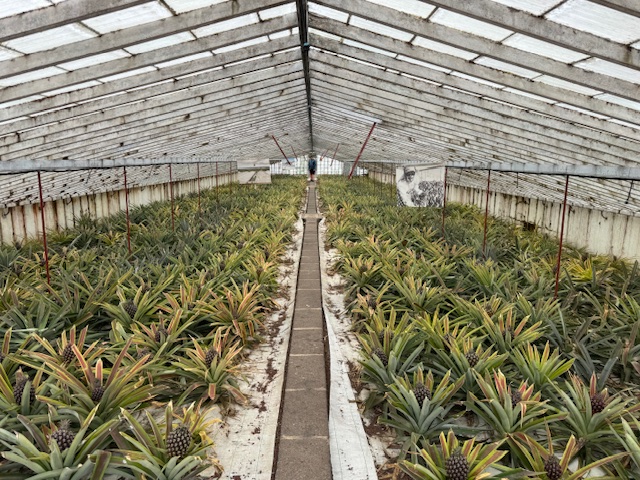
Inside one of the greenhouses on the pineapple plantation. photo gb

We visited a tea plantation (Henrique -our tour guide- worked there when he was younger), and we visited a pineapple plantation.
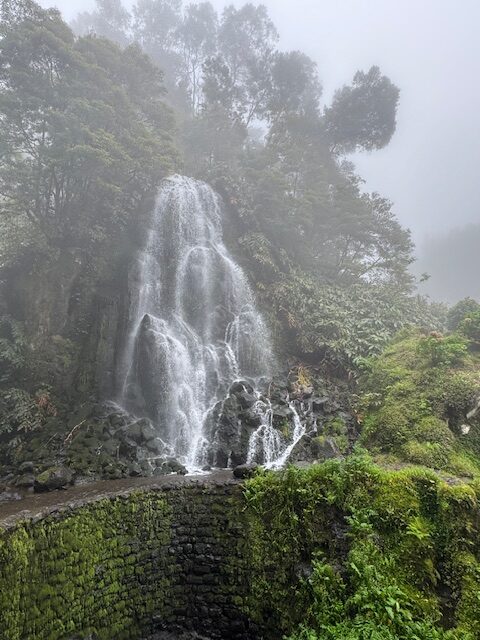
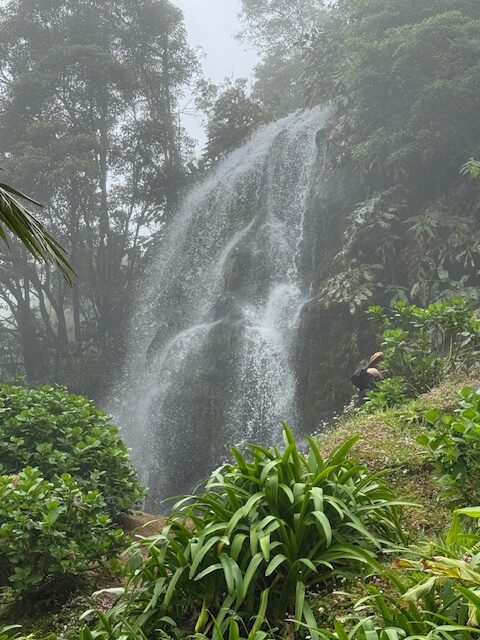
Cascada (Portuguese) = Cascade (English).
Full and lush and green. photo gb

We stopped at Ribeira dos Caldeirões Park, with beautiful waterfalls and more lush, green plants…São Miguel…aptly nicknamed the green island… Ihla Verde.
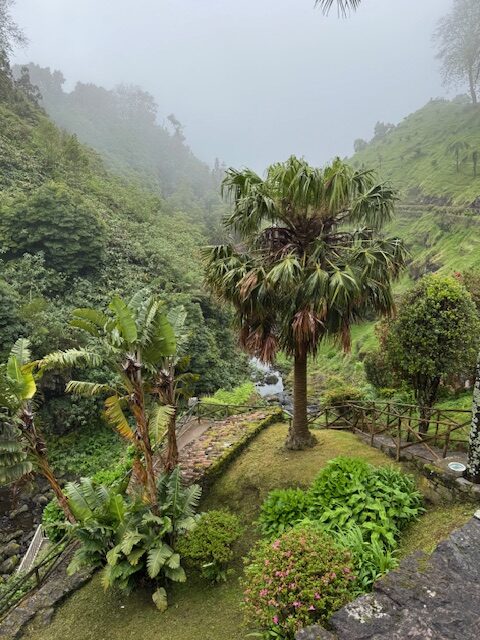
The green island.

On this island we experienced a local dairy farm, milking about 25 cows. It is run by a Gena and João, a couple dedicated to a small, self-sufficent, organic farming operation.

Gena and João, in the barn on their dairy farm. photo gb

As we stood out in the field with the dairy cows, one cow in particular kept nudging everyone. Later, back in the barn (which was connected to electricity just last year) we gathered around the milking stalls and took turns milking a cow by hand.
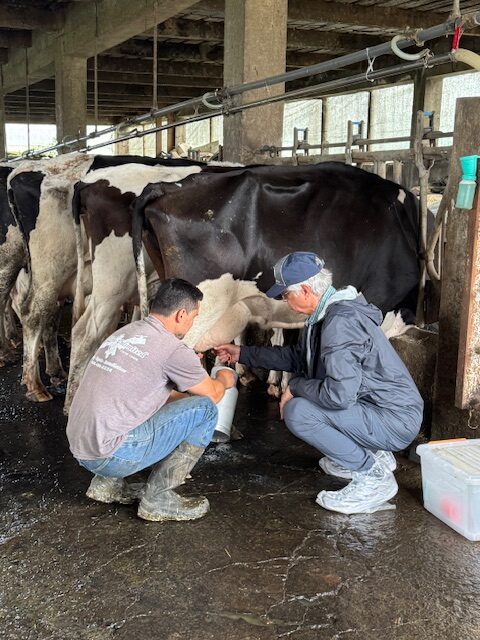
Gary milking a cow by hand.
Henrique at the head of the farm table. photo by Gena

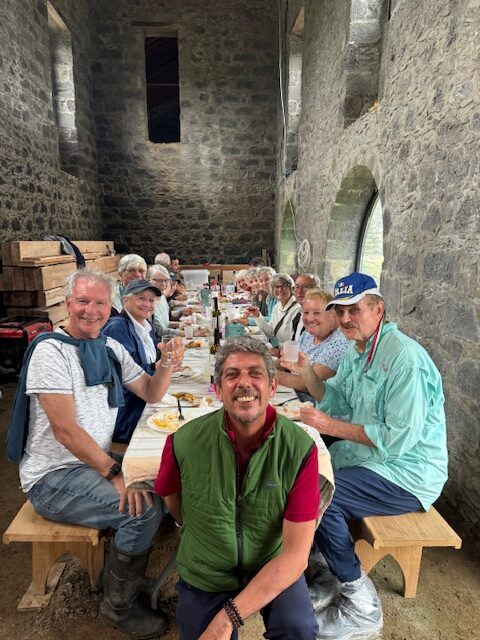
Back in the soon-to-be remodeled stone outbuilding, a wonderful dinner was set for us and we ate their home-grown food. This type of farming reminded Gary of his grandparent’s farm…with their old-fashioned ways of doing things.
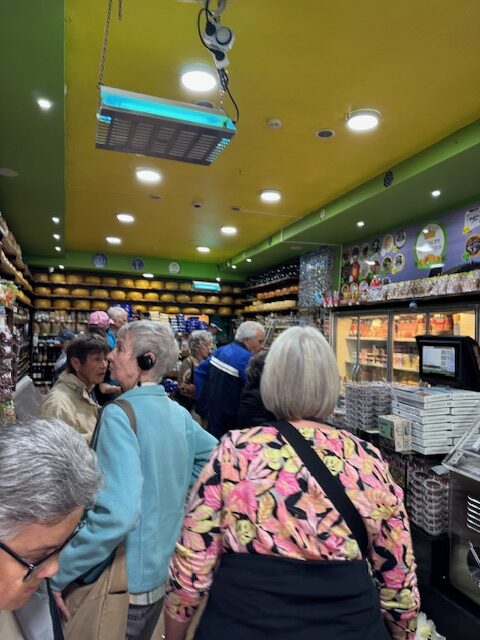
At the grocery store, with our assignments.

Earlier that morning Henrique divided us into groups and gave us some Euros and a short shopping list, in Portuguese, to buy a few items to bring to dinner at the farm later that day.
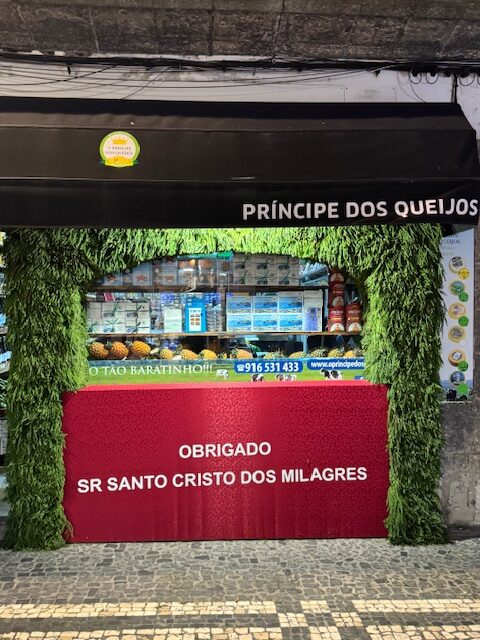
The local grocery store. (Decked out for the upcoming festival. Most store fronts are decorated for the special festival.)

He showed us which store to shop for local fare, and asked us to try and not speak English. That was a fun outing. We succeeded in finding the food…not sure about the not speaking English.
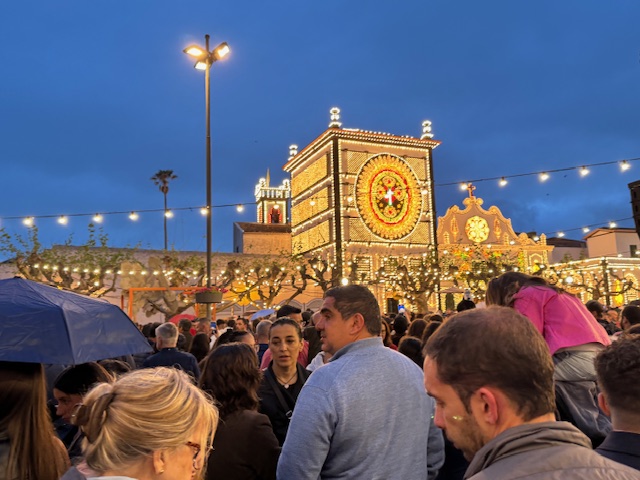
The lighting ceremony on the plaza in Ponta Delgado, on São Miguel Island. The ceremony marks the beginning of the festival “Festas do Senhor Santo Cristo dos Milagres” (Lord Holy Christ of the Miracles).

On our last night on this island there was an opening ceremony for a huge annual religious festival. We were leaving the island the next day, but were able to walk to the main plaza after dinner to watch the lighting ceremony. It was a festive atmosphere and a pretty sight to see.

As I was walking in the cobblestone plaza, I tripped and fell into two women in the crowd. They kept me from falling…I said “Obrigada (thank you)”, and they replied, “that’s what we’re here for – to hold each other up!”  Another fun interaction with strangers!
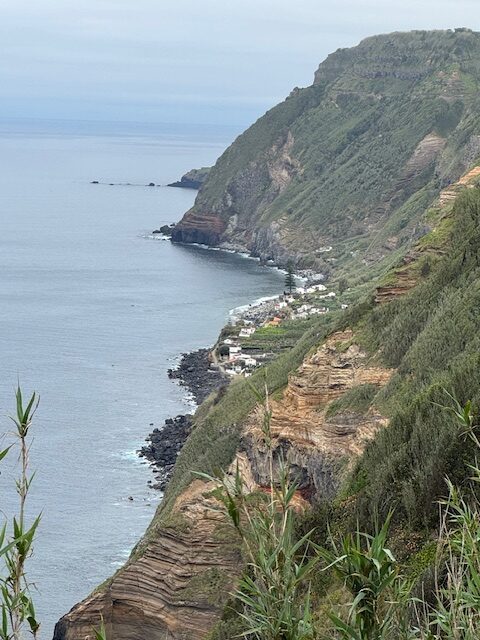
A very small village along the coast of São Miguel. photo gb

We enjoyed the natural wonders and beauty of São Miguel. 
Dairy Farming

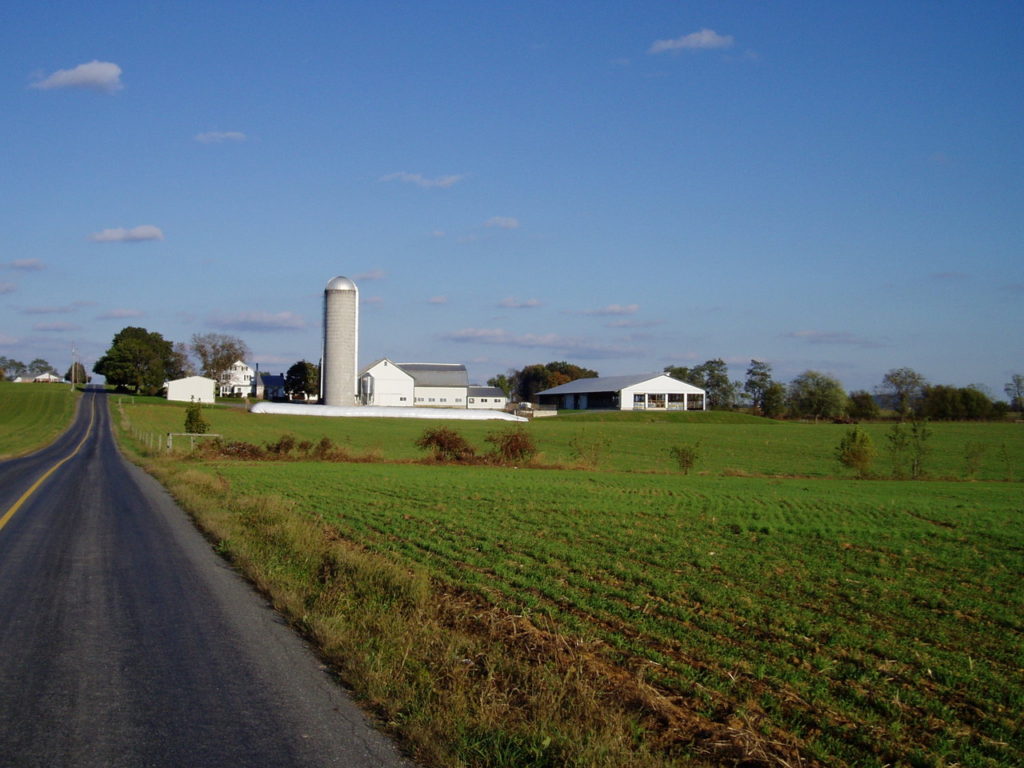
Last week we were in Pennsylvania. Gary, my husband, is from Lancaster County and we flew there to attend a family reunion. He’s is from the scenic part of the state, Amish Country in southeastern Pennsylvania. There are rolling hills dotted with small farms, with cattle and corn and hay fields.

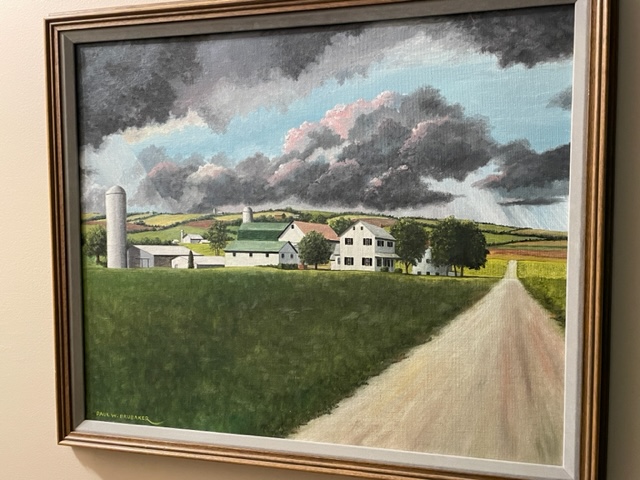
This original painting of the farm where Gary grew up hangs in our hallway. I had it painted for him, as a surprise, about 1980 or so, by one of the ministers at the church he attended with his parents.

Gary grew up on a dairy farm, helping his family milk cows the traditional way, by attaching a milking machine individually to each cow. They milked about 45 cows, twice a day. 

The family farm was sold in 1986 to a young family who continues to milk cows. However, the herd has grown and the operation has changed. The new owners tore down the original barn in the 1990’s and built a state-of-the-art milking parlor in which ten cows were milked at one time, in modern facilities with computer-controlled machines that tracked what each cow produced. 

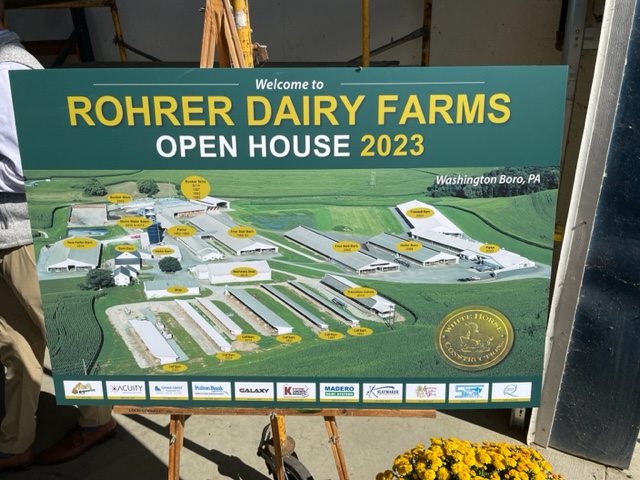
The welcome sign and a layout of the farming facility Gary visited in PA.

Like everything, farming continues to change. This year when we were in Pennsylvania, Gary went to an open house for a 2023 state-of-the-art milking parlor and I asked him to describe it here:

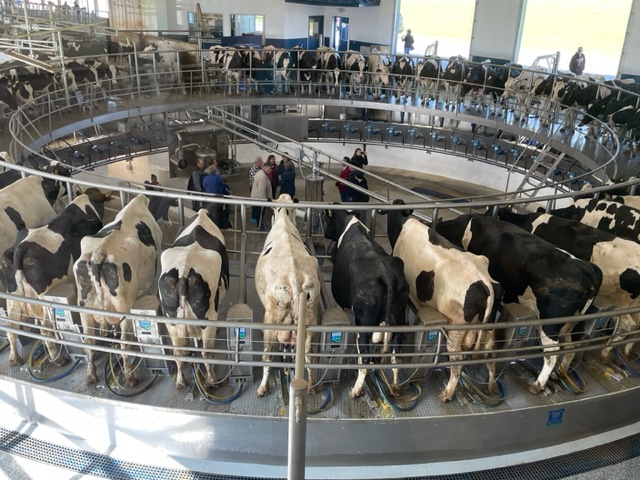
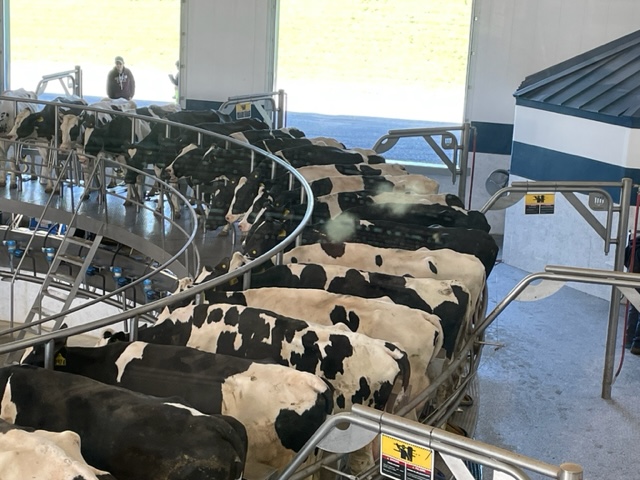
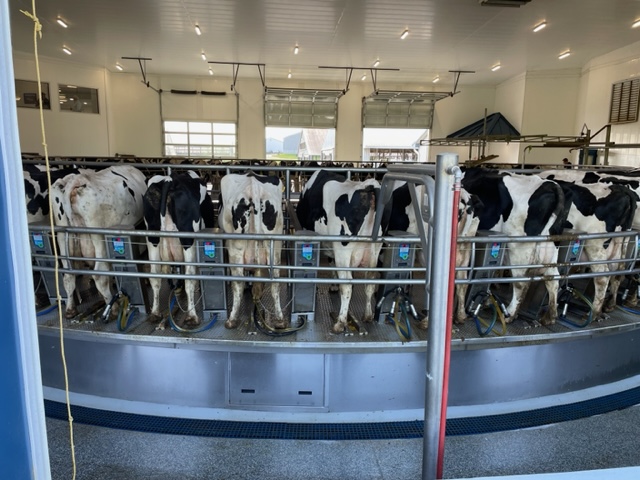
Rohrer Dairy Farms near Mountville, PA began as a small farm with 20 cows in 1956. Fast forward to 2023 and the second and third generation Rohrer Dairy Farm families now have a 60 cow rotary milking parlor to milk their 1,780 cows. This highly automated system is attended by only three employees. The cows enter from holding lanes unto a slot on the carousel as the carousel continuously rotates. Each slot has a milking machine and a control module with a digital screen. 

The first worker preps the cows (washes the udder) and the second worker attaches the milkers. The milking machine automatically disconnects when the milking is complete. When the cow reaches the exit point, a water spray at her head encourages her to back off the carousel. Unless there is a hiccup, the carousel does not stop. It rotates very slowly and each cow’s ride on the carousel is about ten minutes. 

It is an amazing sight. There is an upper level gallery with office, conference room, meeting room and viewing area where one can watch the whole operation behind large windows.

They milk three times a day and each milking takes 5 ½ hours, thus there is more milking parlor time available to expand the herd.

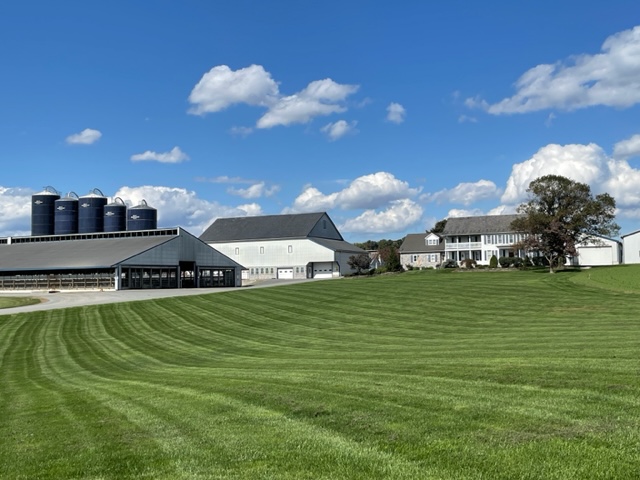
This is a partial view of the Rohrer Dairy farm.

In addition to the 1,780 milking cows, they have about 1,500 heifers and calves. The large cow barns have automated feed systems, slotted floors with manure pits underneath, and a fire sprinkler system. 

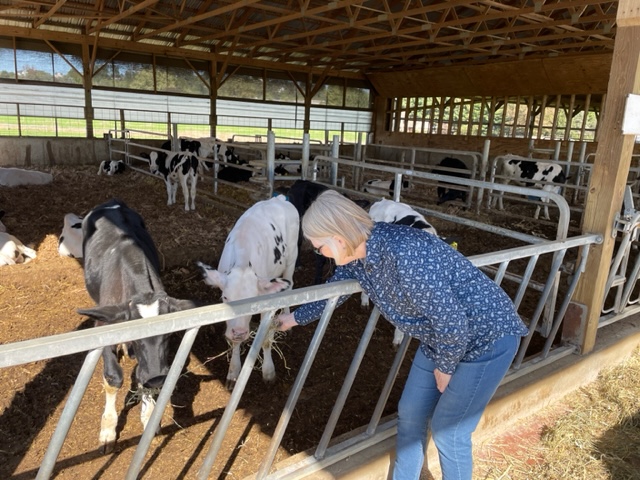
Both of Gary’s sisters are dairy farmers. We did visit both farms, and here I am feeding a calf at one of them.

It is hard to comprehend. The small family farm is indeed rapidly disappearing, but I believe they both can co-exist. I am hopeful because my sister’s son and his wife, both of whom are college graduates, are taking over their parent’s dairy farm. They milk less than 100 cows in a traditional milking barn. Good for them!

A Polo Match

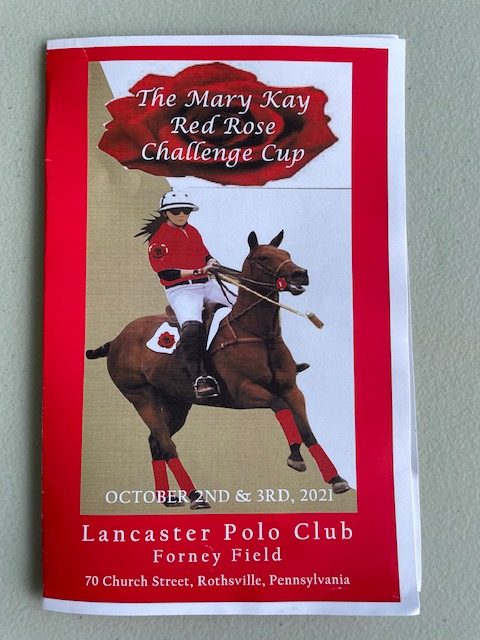
The area we visit in Pennsylvania has a lot of dairy farms, therefore we see a lot of cows grazing in the meadows. We see horses pulling buggies, but not many in the fields, so I was surprised to see a sign posted along the road stating, “Polo Match Today 2:30 pm” with an arrow showing which direction to go. I said out loud, “I want to go to that”. When I told the others, we all (4 of us) decided to go to watch the polo match that Saturday afternoon. 

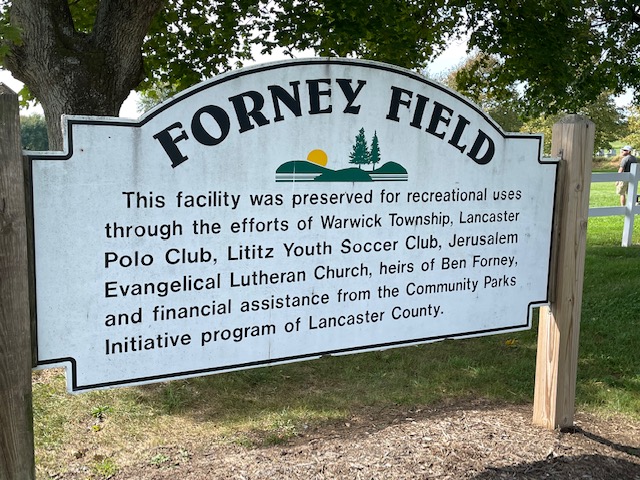
Daryl (Gary’s brother) and Gary knew about “Forney Field” where the polo match was to be held. The land was donated by their great uncle…their grandmother’s brother, Benjamin Forney. Since the game of polo is usually played on Sunday afternoons, Ben Forney was considered a “black sheep” of the family for promoting the sport (Sunday is a day of rest).  It was fun to learn a little about Ben and know the polo club he started back in the 1930’s is still going strong today.

The general admission area.

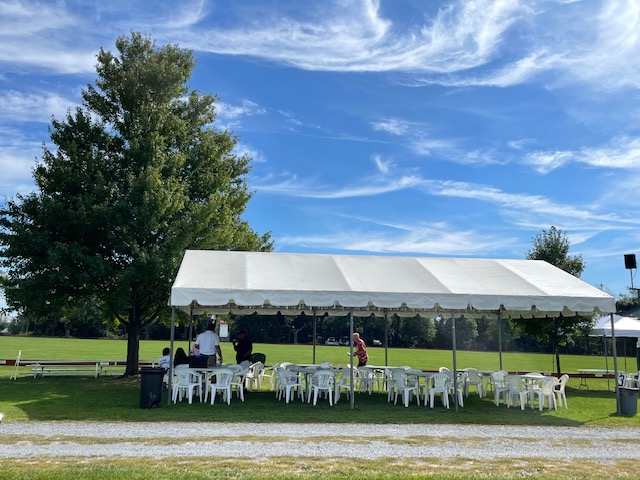
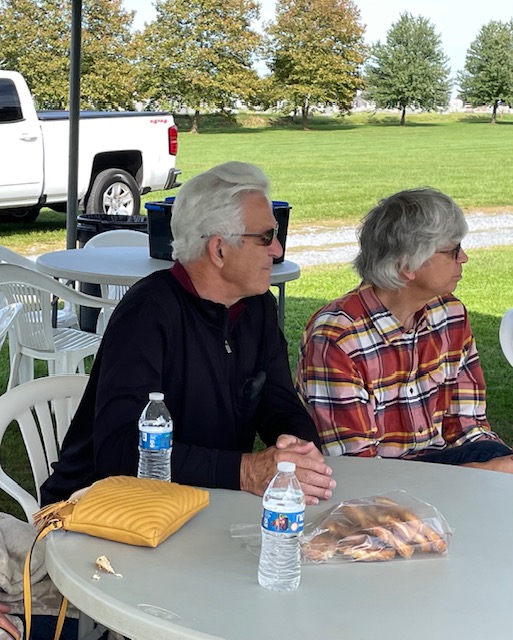
We arrived at “Forney Field” and my brother-in-law mentioned we were family so they let us in for free. We sat in the general admission section, at a front row table under a tent. It was great viewing.

Ben Forney’s great-nephews.

The announcer was nearby so Gary and Daryl went to talk with him and he was interested to hear a bit more about Ben Forney. Then he announced to the audience that the nephews of Ben Forney were in the audience. It was quite comical, but we had a lot of fun.

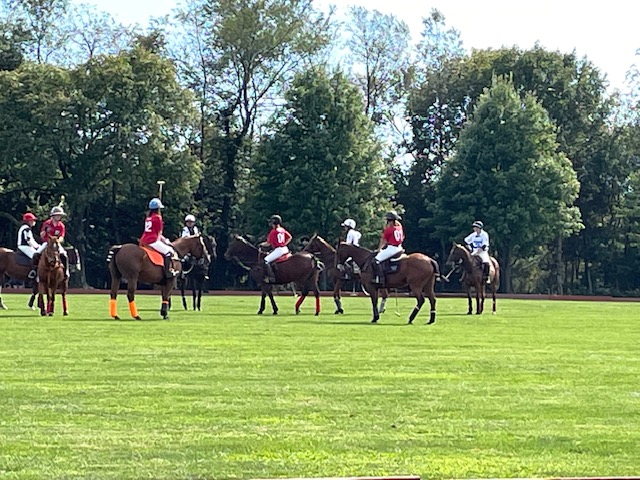
There are four players on each team.

We learned a little about the game too, from the announcer who was an ex-polo player and enthusiastic promoter of the sport. He filled us in on a few details of the game…like the time periods are called “chukkers” and the team’s goal post changes after each score, to allow fairness with wind and sun distractions.

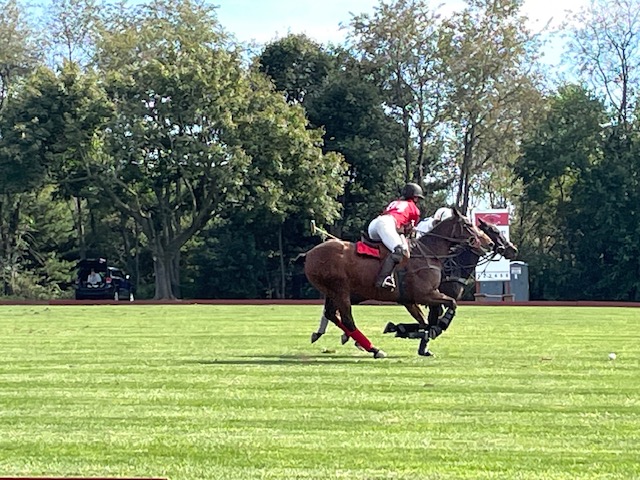
Two horses, “neck & neck”.

We were watching a tournament game. All the payers in this game were women, ages 13-47. The players are amazing to watch…galloping with the horses while reins in one hand and a long handled, mallet in the other, trying to hit the “ball”. There are four players on each team.

We had been to a polo match in Minnesota, years and years ago, and I have always wanted to go watch the majestic game again. Never did I think I would go to one in Pennsylvania, a couple miles from my brother-in-law’s house.

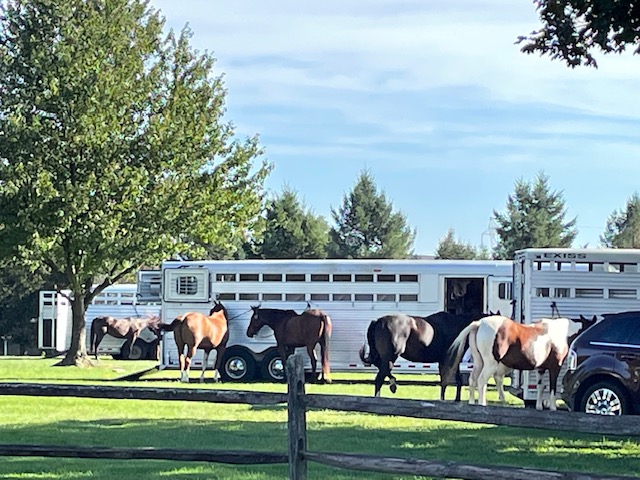
The horses after the game, behind the scenes.

Lancaster County

Lancaster County Pennsylvania is a unique spot in the US. My husband grew up on a small dairy farm in the rolling hills of this southeastern county of Pennsylvania, surrounded by more small dairy farms. It is very picturesque. There are a lot of Amish, Mennonites and Brethren that have farms and businesses and add to the uniqueness of this county in Pennsylvania. 

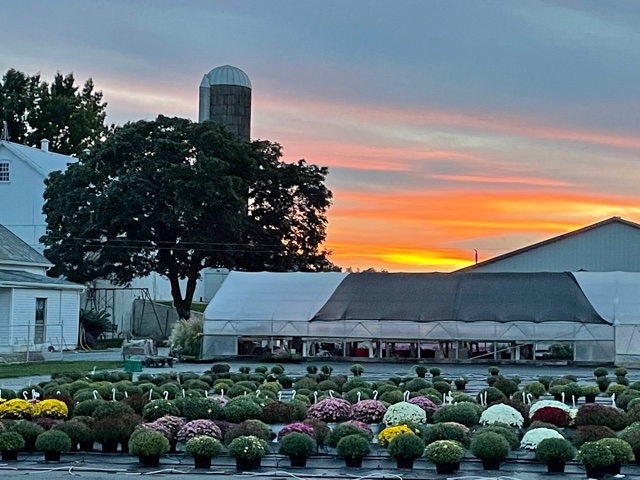
A sunset over a farm, growing mums…

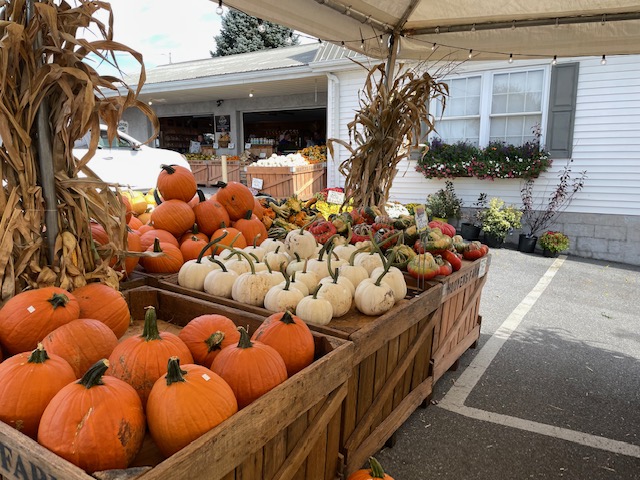
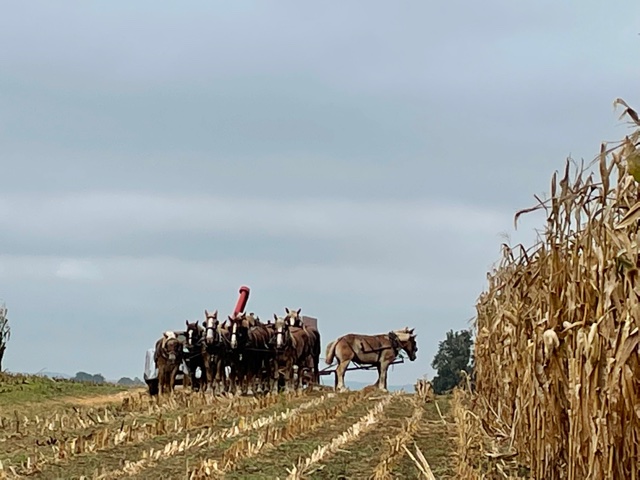
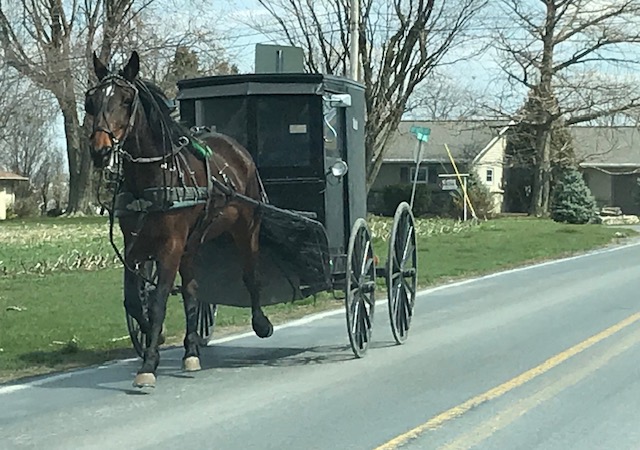
Beautiful small (and large) farm markets are everywhere and we saw teams of mules in the fields, and horse and buggy’s on the streets. There are covered bridges, immaculate gardens, and narrow roads. And many, many beautiful old buildings and barns and houses.  

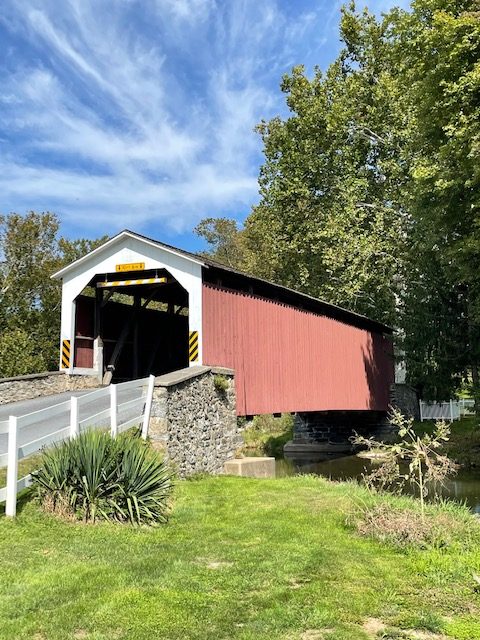
Erb’s historic covered bridge (1887), on the backroads of Lancaster Co., PA.
One of the many farmer’s markets we saw on our drives.
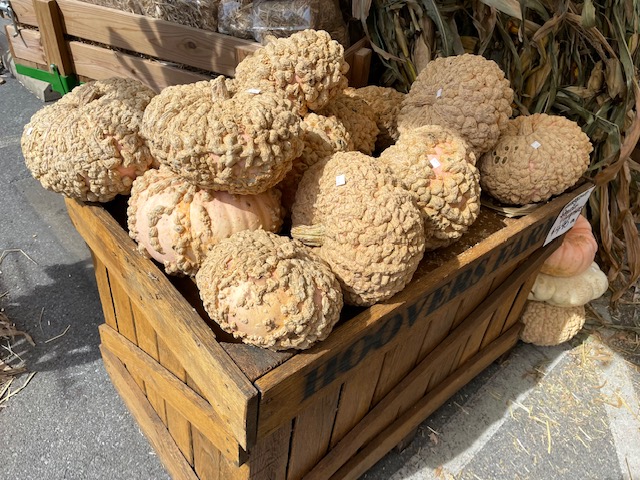
A first for me…peanut pumpkins!
A hard way of doing farm work, but looks charming.

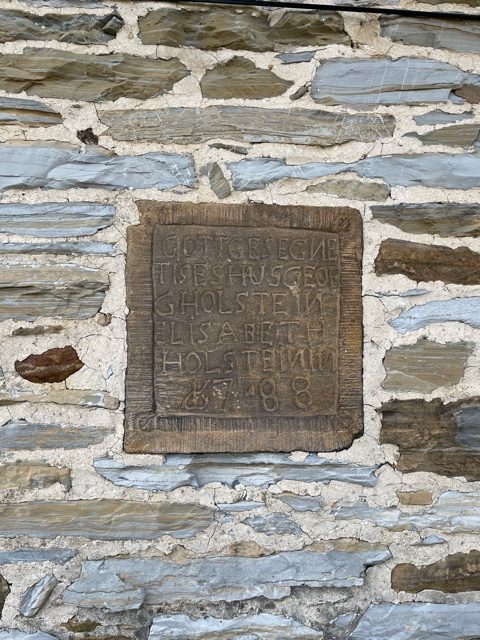
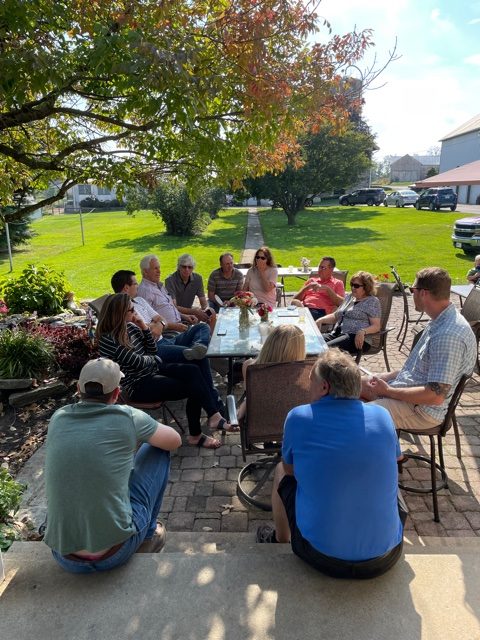
On Sunday the family gathered at Gary’s sister’s farm. It was fun to be together and visit with one another (and I love all food at a potluck). Gary’s sister and her husband are dairy farmers, and they live in the house her husband grew up in. It is a lovely, old limestone house, well maintained, and the engraved wall plaque dates it to 1788.

Wall plate imbedded into the limestone wall…1788.
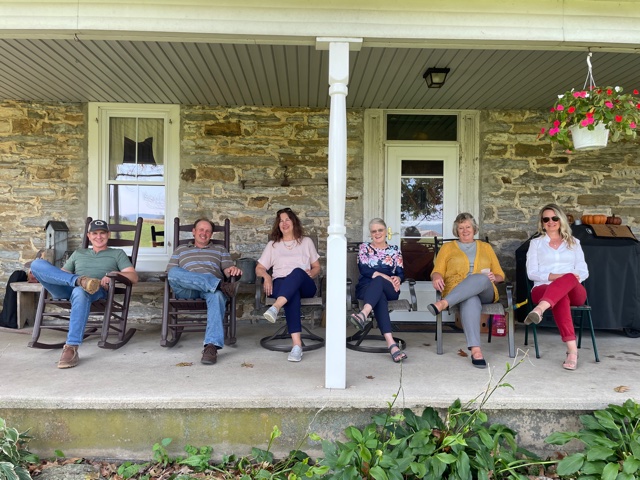
Enjoying the porch of this lovely home.
A family gathering.

Each time we visit Pennsylvania we go see the farm where my husband grew up. A Mennonite family bought it thirty years ago. They have electricity, but are not allowed to drive cars…so they get around with the horse and buggy.

Photo take on a previous trip.

They are kind folks, and always welcome us into their home and invite us to look at all the changes they’ve made around the farm. They have a modern milking parlor, but do not make use of the data collection feature because they do not have a computer.

A previous photo of Gary’s childhood farm. photo by gb

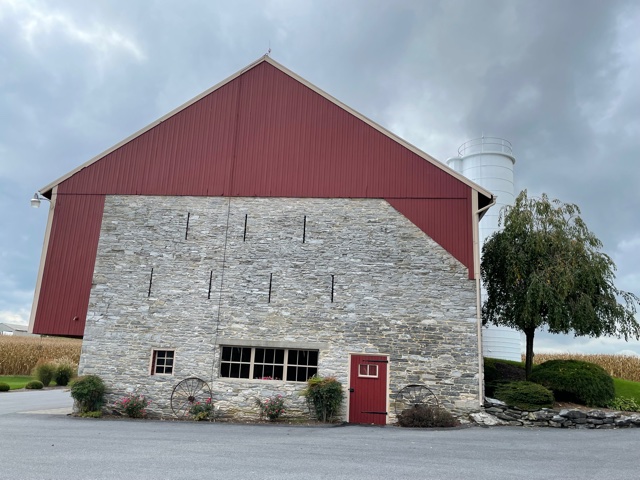
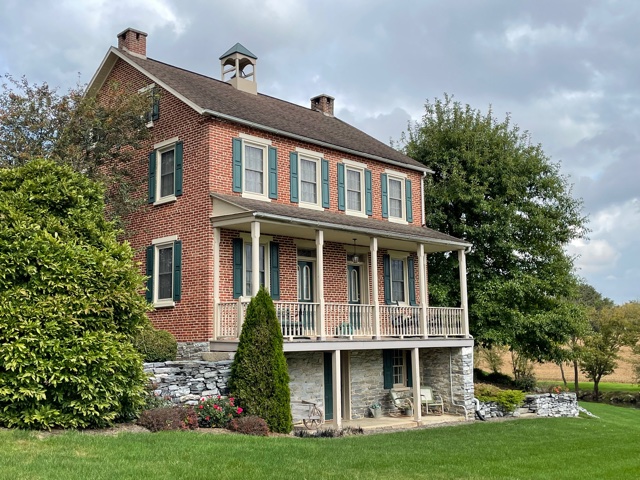
Another farm we visited this year was a farm that had four generations of Bollinger’s living on it, from 1855 to 1998. The farm house and buildings were bought by a local man who restored the home and barn to its original appearance, and it is stunning.

The restored barn that once was owned by four generations of the Bollinger family. We know the barn was built prior to 1830.

It was wonderful to see all he had done. For example, the brick house had been painted with three layers of white paint and it was stripped to the original brick, and repointed (grout redone).

The beautifully, restored house next to a creek.

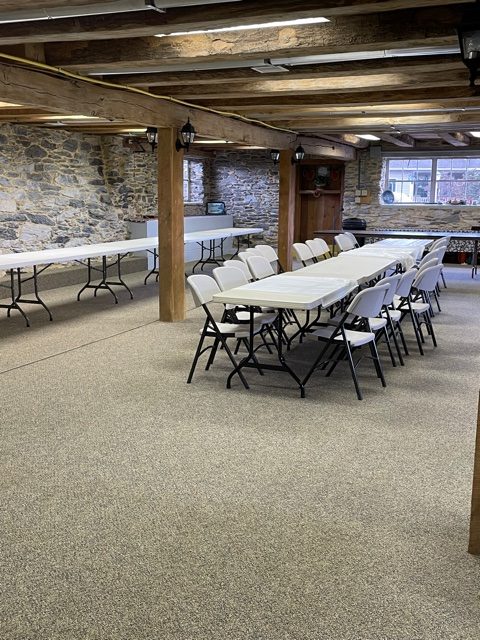
Another example is the inside of the barn. It was refurbished and they added a restroom and have family gatherings and church events in it. We are grateful he and his wife are enjoying this historic place, and at times with their 41 grandchildren! 

Inside the old, restored barn…a wonderful event space for the family,.
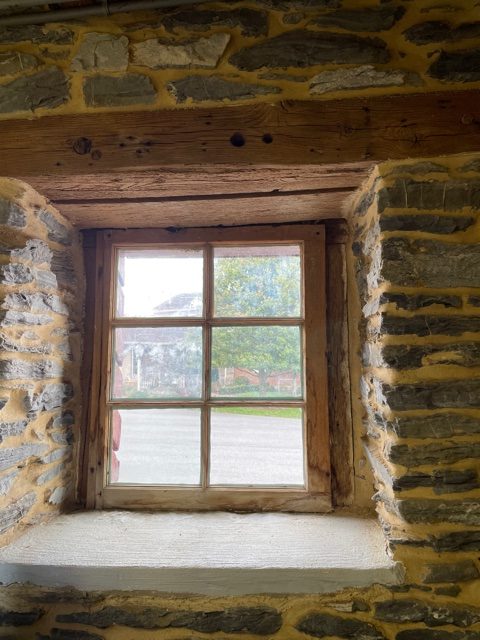
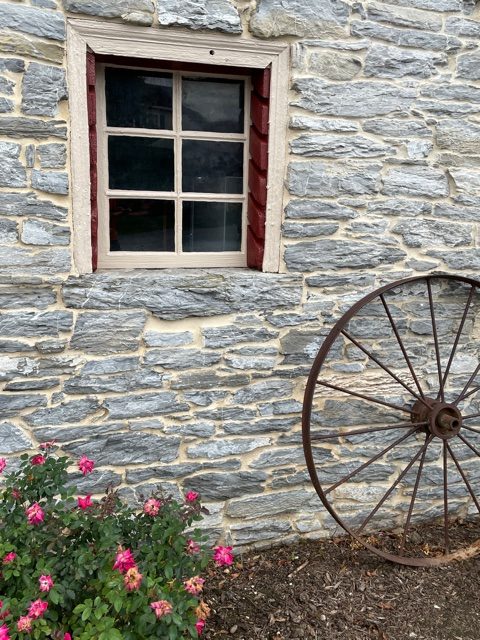
The deep window sills of the old barn.
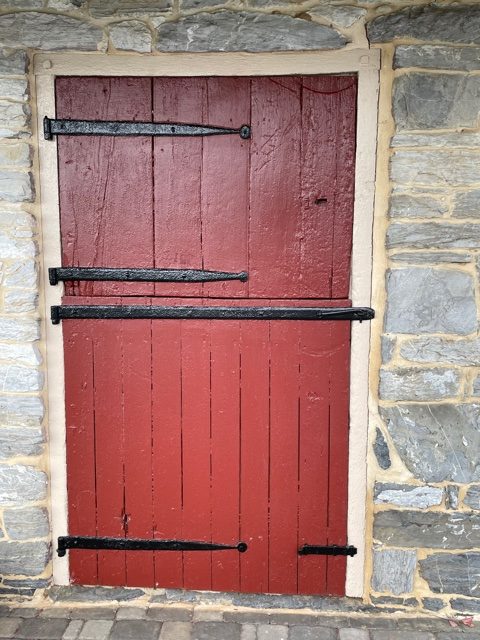
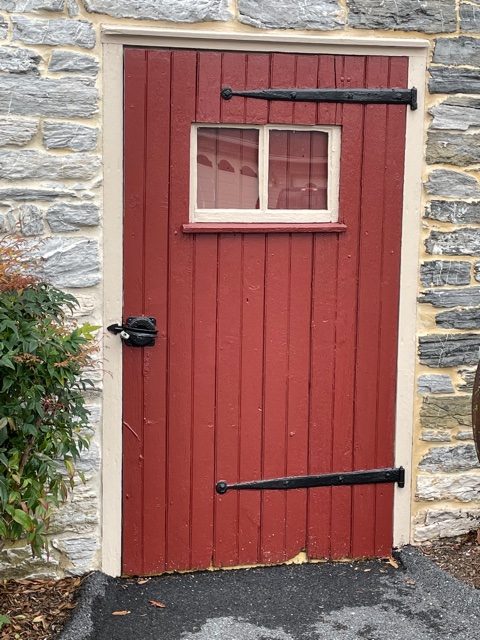
Repainted barn door with original, iron hardware.
The barn is also re-landscaped on the outside.

There is so much history in the area. Gary likes researching his genealogy, and has traced his roots back to Rudolph Bollinger who arrived in Pennsylvania from Switzerland around 1720. 

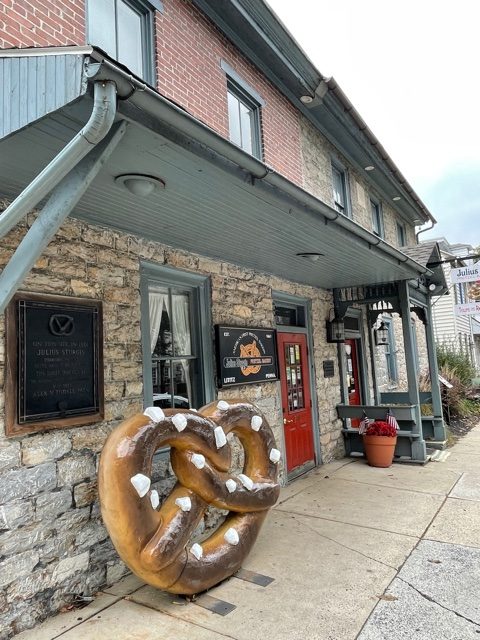
Julius Sturgis Pretzel Bakery, founded in 1861, is the first commercial pretzel bakery in America, in Lititz, PA.
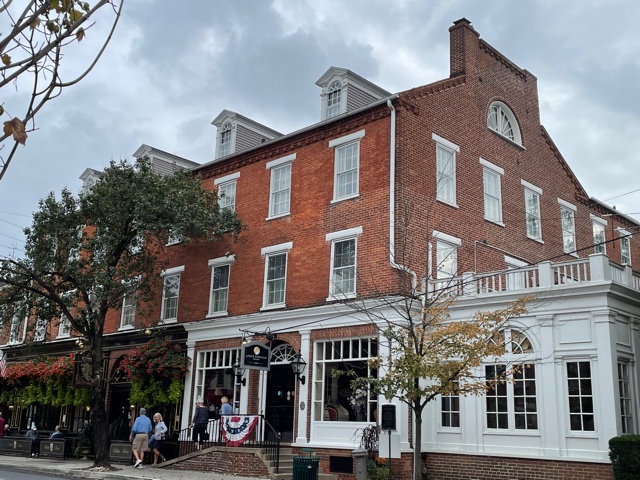
The Lititz Inn and Spa, built in 1764, an historic inn in Lititz, PA.
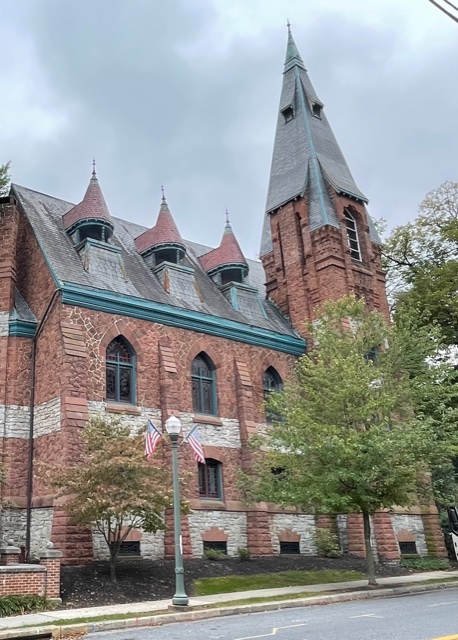
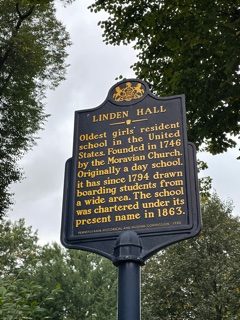
An old church near Linden Hall, an all girl’s school, founded in 1746, in Lititz, PA.

We enjoyed seeing friends who drove down from New Hampshire and joined us for a couple of days. It was fun showing them around.

It’s always proper to eat some local fare when visiting this area, such as shoo-fly pie, tomato pie, and lots and lots of ice cream from the local dairies. Not too hard to do!

Another restored door on the old Bollinger barn.