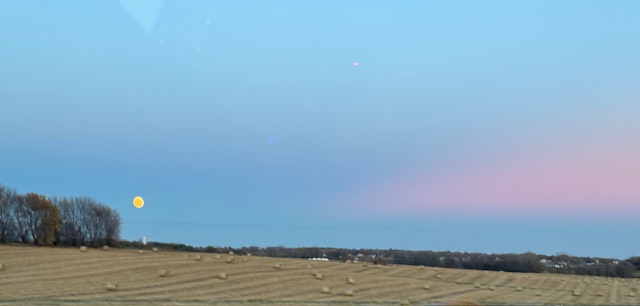
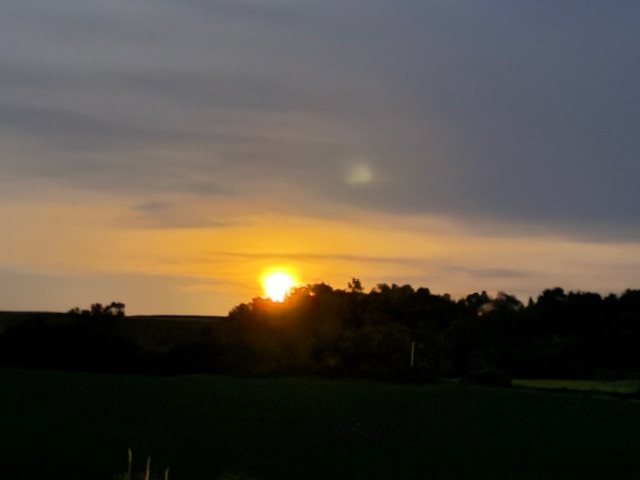
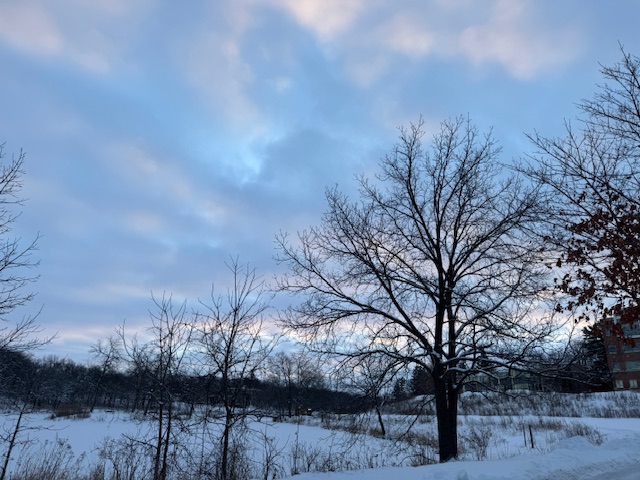
I took this picture from our car window driving up Cedar Avenue towards the airport last night, November 5, 2025 at 5:01 pm. The coloring changed so much from 8 minutes earlier.
The most common name for November’s full moon is the Beaver Moon. Apparently it’s so named because beavers are busy building their winter dams in November.
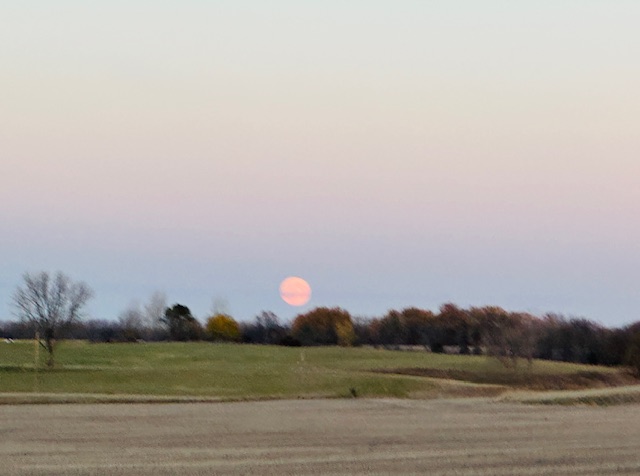
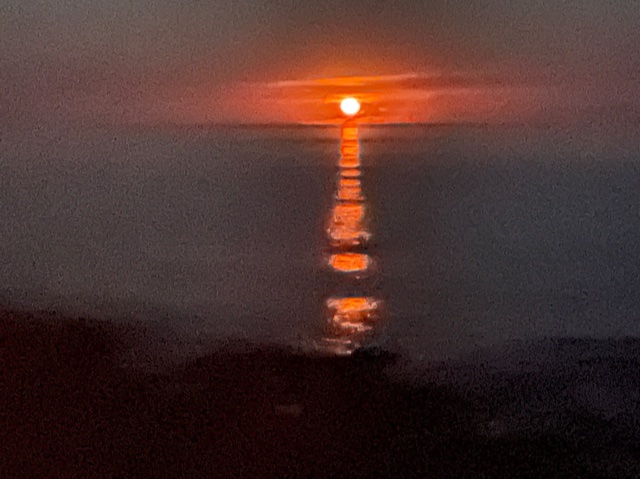
The is the first picture I took from the car of the full moon rising. I zoomed in and the photo is a bit grainy. (11/6/25 4:53 pm.)
November’s full moon has two names…it can also be called the frost moon, because frost is usual in Minnesota during this month.
November’s full moon, on November 5, was a supermoon. It was the largest and brightest moon of year (the distance from the earth was the closest). There are three supermoons in 2025…October, November and December.
No matter what time of the year, it’s always spectacular to see the moon.
When I was younger, I wrote a letter to Pan Am Airlines (a viable airline at the time) asking to be put on their waitlist to go to the moon. They wrote back (I was amazed), and told me the list was full!
I guess I’ve always been fascinated by the moon. I do enjoy the moon, and especially a full moon. Seeing the moon’s reflection on the water is always spectacular. But, crescent moons are sweet too…like a wink, or smile from heaven.
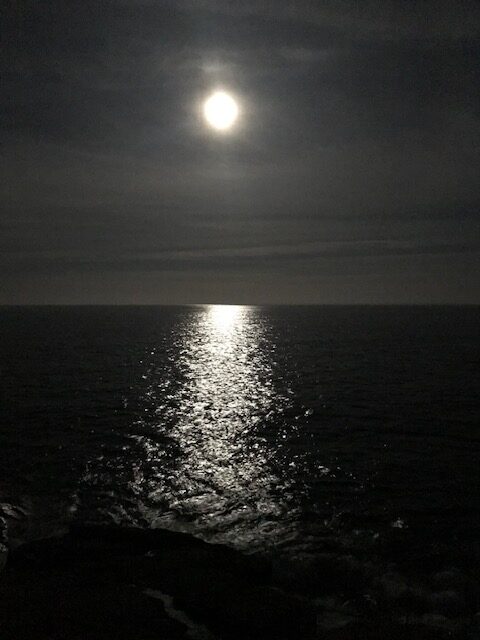
Full moon over Lake Superior, Minnesota 2020.
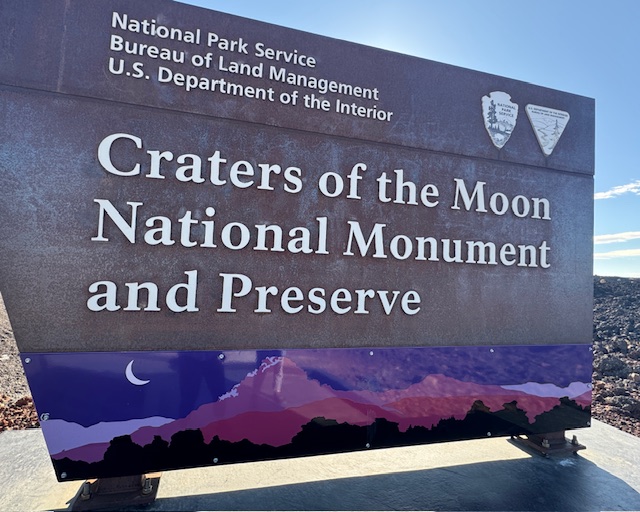
So, when I saw on Idaho’s map, Craters of the Moon National Monument, I added it to my list of places to see in Idaho. It is a 750,000 acre park. According to the internet, the difference between national park and national monument are:
“...are their establishment [1] method, [2] primary purpose, and [3] scope of preservation. National parks are created by an Act of Congress to preserve a broader scope of natural and recreational values, while national monuments are designated by the President under the Antiquities Act to protect a singular, significant natural or natural object.”
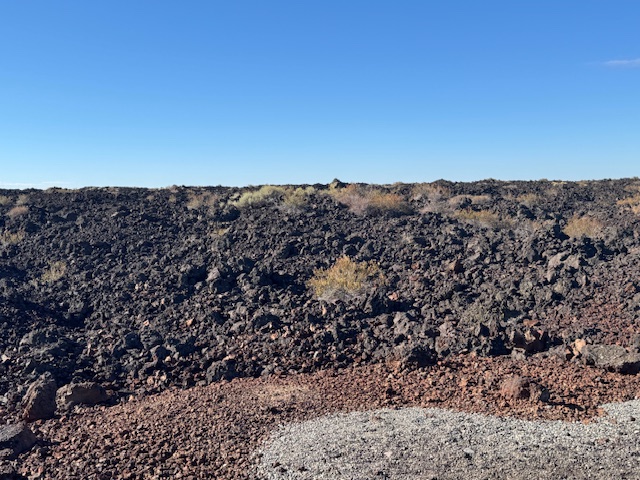
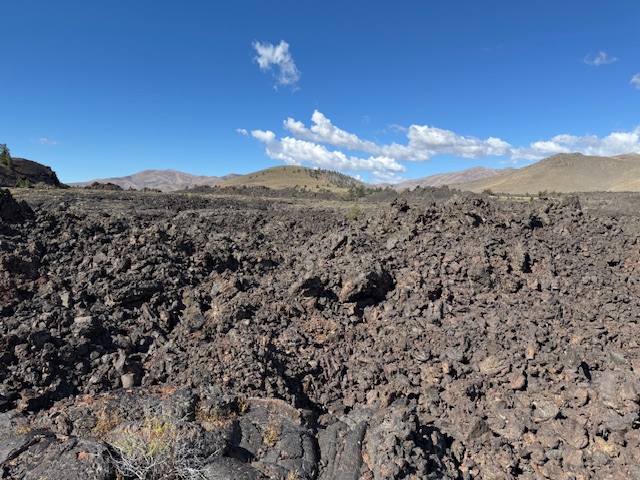
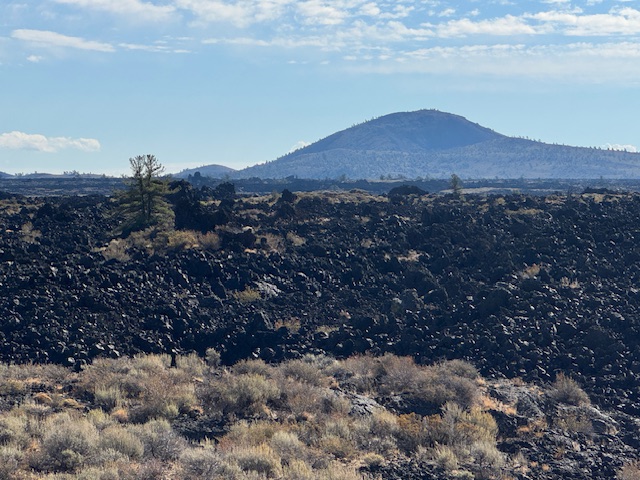
It was a sunny, but chilly day when we visited the Craters of the Moon National Monument. It features vast lava fields deposited from volcanic eruption of deep fissures years ago. At the Visitor’s Center we picked up a map of a seven-mile driving loop through the park. There were designated stops along the way to get out for a scenic overlook, or take a hike. We did both.
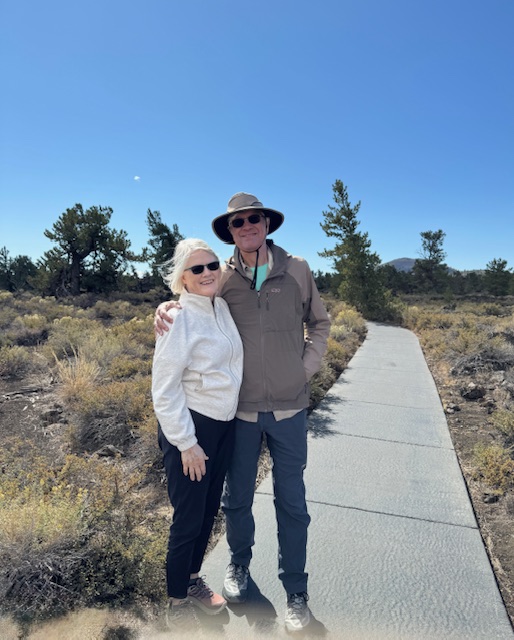
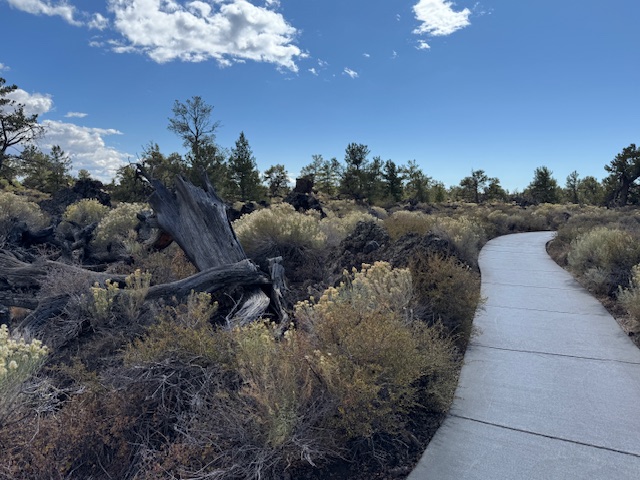
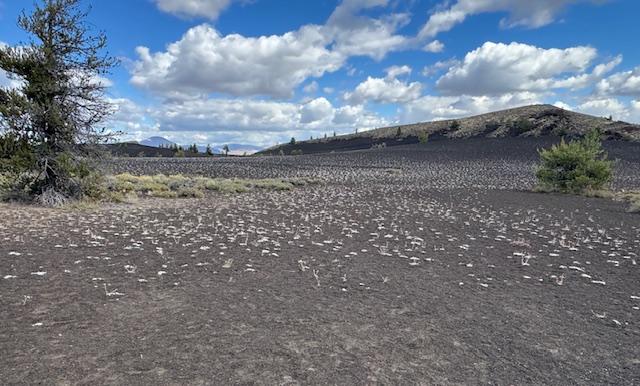
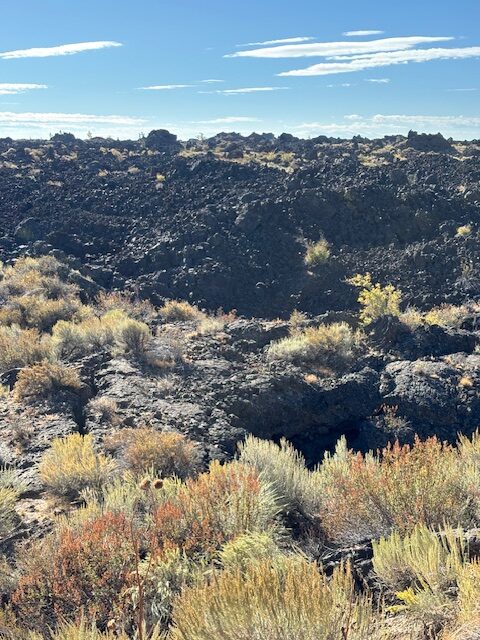
The short hike through Devil’s Orchard was level, and paved, and I felt like we were walking through a strange botanical garden. Although we missed the peak for wildflowers in the park, there is amazingly diverse plant life in these lava fields. Most common is the sagebrush.
Walking through the Devil’s Orchard.
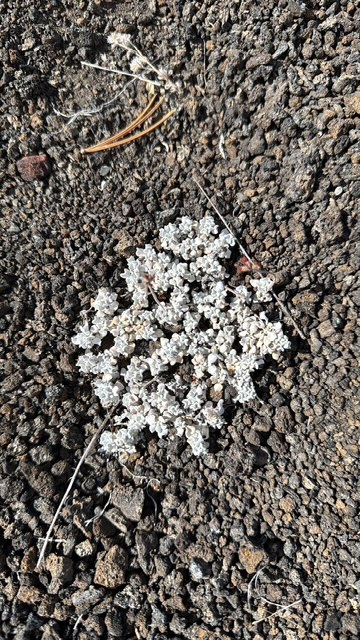
Dwarf buckwheat is an interesting plant…they look like white spots dotted almost evenly on the black lava rocks…
Dwarf Buckwheat
Dwarf Buckwheat growing like polka dots on the dark terrain.
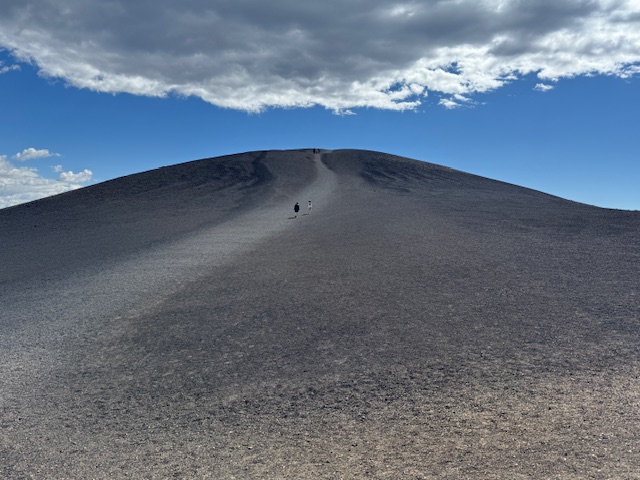
There are numerous mini volcano formations known as spatter cones and cinder cones. We hiked up a cinder cone named Inferno Cone.
Climbing up Inferno Cone, 6181′.
A cinder cone is formed from the accumulation of gas-charged volcanic fragments (cinders) ejected from a single vent.
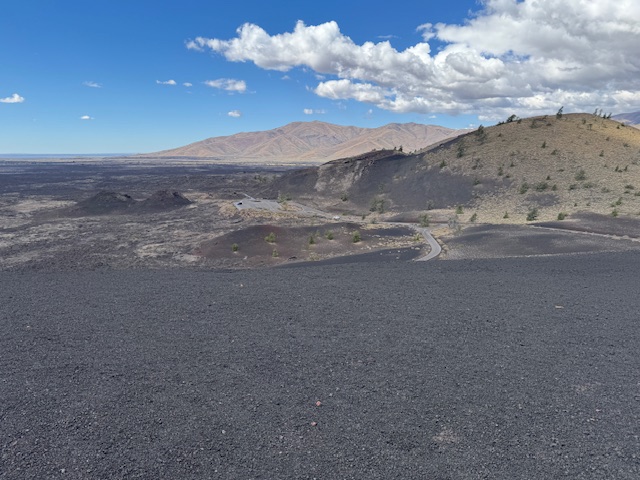
On top of Inferno Cone…the top is level, but the cinder line on this photo is where the steep conical sides meet at the top.
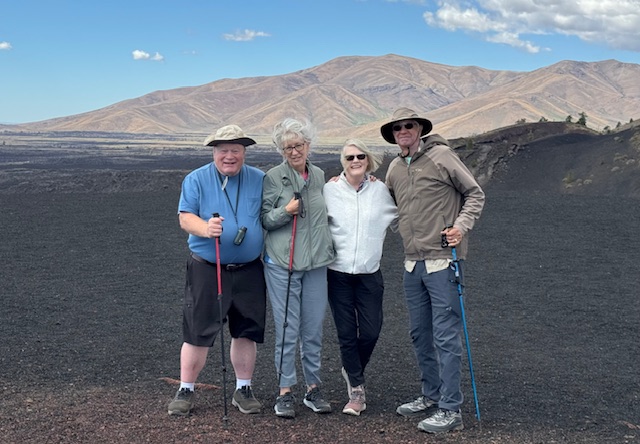
The hike was a steep climb, but worth the view at the top.
At the top on Inferno Cone.
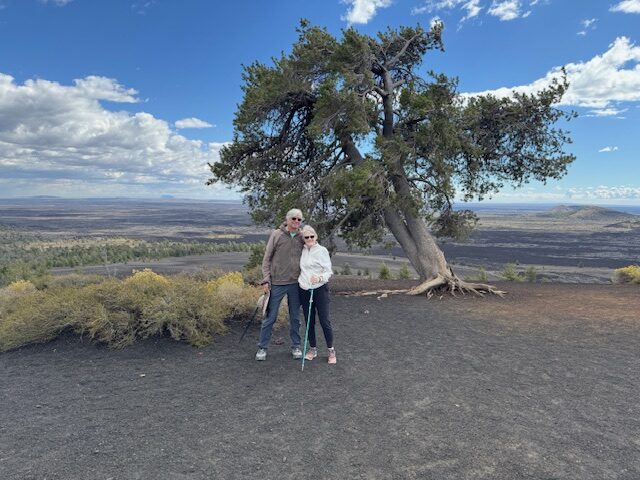
It’s so hard to show depth in a photo. This tree is hanging over the edge of the cinder cone.
From the Craters of the Moon brochure, “astronauts confirmed that most lunar craters resulted from meteorite impacts, not volcanism. The craters of Craters of the Moon however, are definitely of volcanic origin…. from a series of deep fissures known collectively as the Great Rift that cross the Snake River Plain.”
I may not have gone to the moon with Pan Am, but I think I am satisfied with seeing Craters of the Moon and its diverse landscape. When you enter the park and drive through this amazing area, it sure looks like you are on the moon!
It was a great adventure.
Although not related to the moon adventure, we visited another site in the Idaho wilderness worth mentioning.
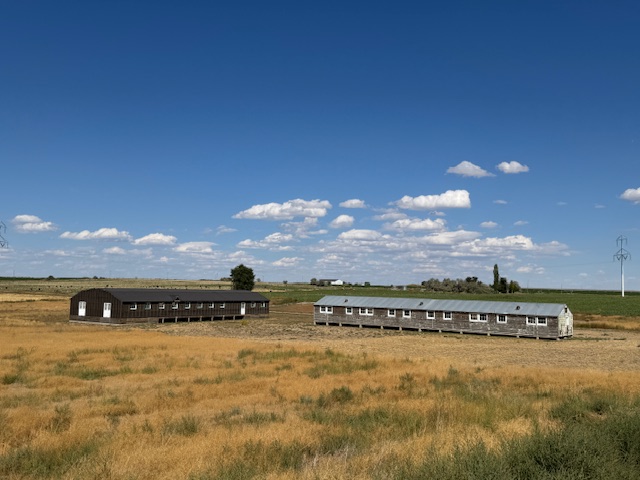
A barrack and the mess hall at Minidoka Internment camp.
The Minidoka National Historic Site is remnants of a Japanese Internment camp. We drove miles into the desert to find the visitor’s center and the remains of a few camp buildings. During World War II this camp held over 13,000 (out of 120,000) Japanese Americans who were forcibly removed from their homes and incarcerated without due process of law.
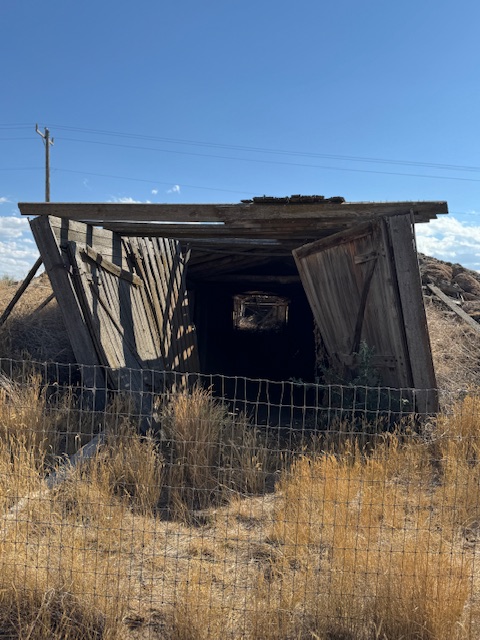
A root cellar built by those incarcerated to store crops grown at Minidoka. It is surprisingly large.
As most Visitor’s Center are, this one was full of information. And to make our visit even more interesting, the National Park ranger we talked with was a granddaughter of one of the incarcerated. Her grandfather was interned at this very Camp Minidoka. She was passionate about its history and she could answer any question we asked. The site preserves a real, but sad chapter in our history.
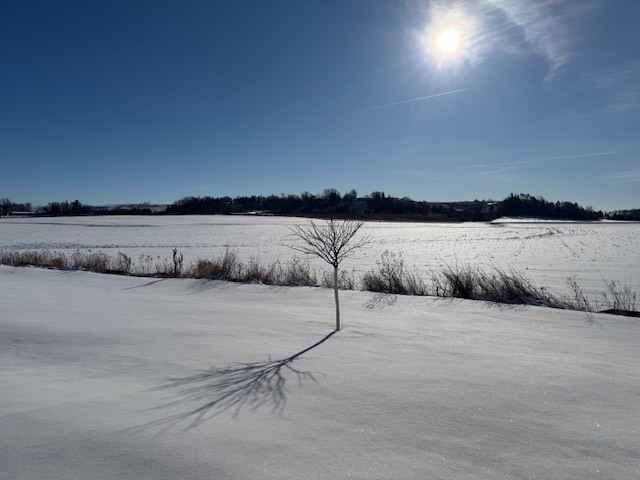
We woke up to six inches of snow Thursday morning. It’s been a while since that has happened. Last winter Minnesota was practically snowless. The fresh, white snow was pretty lying over the harvested cornfield outside the windows of our new sunroom.
Photo taken 12/20/24. The sun has come out!
It was cloudy when the full moon rose on December 15th, but I can imagine the scene; moonlight on the field of freshly fallen snow. It reminded me of a poem I read recently:
December Moon

Before going to bed,
after a fall of snow,
I look out on the field shining
there in the moonlight.
So calm,
untouched and white.
Snow silence
fills my head after I leave
the window.

Hours later, near dawn, when I look down again,
the whole landscape has changed.
The perfect surface gone, criss-crossed and written on
where the wild creatures ranged
while the moon rose and shone.

How much can come,
how much can go when
the December moon is bright.
What worlds of play
we’ll never know
sleeping away
the cold, white night
after a fall of snow.

~Author unknown
(This poems seems to be a rework of May Sarton’s December Moon poem: here is a link to May’s original poem. I cannot find any information on who wrote the words above.)
I like the image of animals leaving their tracks in the snow, as evidence of their nightly esapades. And, I’ve always be attracted to the moon and its tales and lores.
Light breaking through the clouds. 12/20/24
A lot is happening during this season of change…the full moon, the fresh snow, the winter solstice (December 21), which marks the longest night of the year. After Christmas with its many variations of light, after the New Year’s celebrations, after we settle into the new year, the days start getting longer in our corner of the world, and we will be gifted with more light, and that is very good.
On Wednesday afternoon, we arrived at our beloved cabin we rent on Lake Superior, two days/nights after the full moon. I always love to see the full moon over Lake Superior but we do not plan our trips around it…however, a lot of times the dates do work out and we’ve seen the moon rise over the lake many times…I love it!
Since the full moon was only two nights ago we planned our campfire on the rocks to coincide with the moonrise. And…at precisely, 8:01 pm, as posted on the meteorological site predicting sunrises and sunsets, moonrise and moonsets, it, indeed, rose.
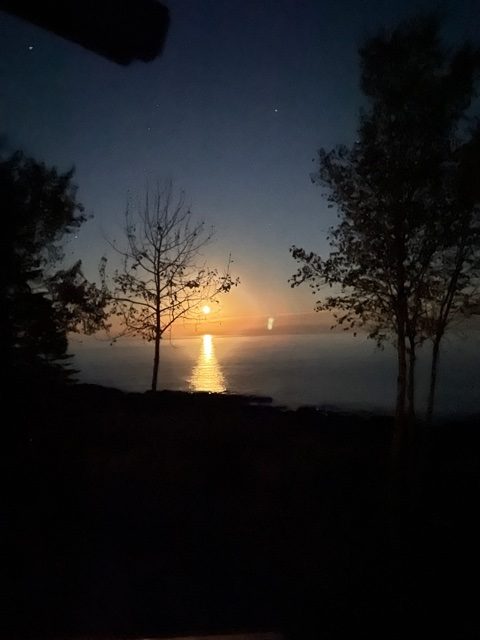
Almost full moon September 22, 2021
However, the unique thing about this evening’s moon rise was we saw it rise two times! It came over the horizon at 8:01 and was gorgeous, a huge orange ball…we saw it come up in its entirety.
However, there was a low cloud in the sky, on the horizon, and the moon went behind that cloud and we could not see it for a few minutes…then lo and behold, we saw it rise again over the cloud for a second moonrise, and this time the moon shone bright and white.
The moon over Lake Superior, September 22, 2021.
What a gift. What a blessing. What an amazing time to be sitting on the rocks on Lake Superior, in front of a campfire, watching the moonrise, twice!
50 years ago today, July 20, 1969, the famous Apollo 11 mission allowed the first man to step on the moon. We all know he was Neil Armstrong who died in 2012 and is not here to help commemorate the anniversary of this historic event. Buzz Aldrin was the 2nd man to step on the moon, while Michael Collins remained in the command module. There are lots of celebrations being planned for the 50th anniversary, and many remembrances retold and some revelations of seldom told stories.
One story being that Buzz Aldrin carried communion elements along with him to the moon and asked for a private moment to take communion and read a verse from the gospel of John after they landed on the moon.
“In the radio blackout, I opened the little plastic packages which contained the bread and the wine. I poured the wine into the chalice our church had given me. In the one-sixth gravity of the moon, the wine slowly curled and gracefully came up the side of the cup. Then I read the Scripture, ‘I am the vine, you are the branches. Whosoever abides in me will bring forth much fruit. Apart from me you can do nothing.’”
I like that story.
And another very little known story from that era… when I was a teenager I sent a letter to Pan Am Airlines asking to be put on their waitlist to go to the moon. And, believe it or not, they wrote back and told me the wait list was full! HA!
I guess I’ve always been adventurous. I wonder if any airline is taking reservations to the moon at this time???
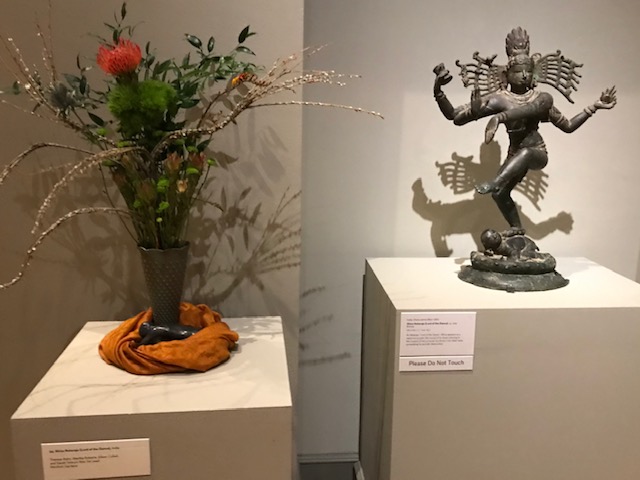
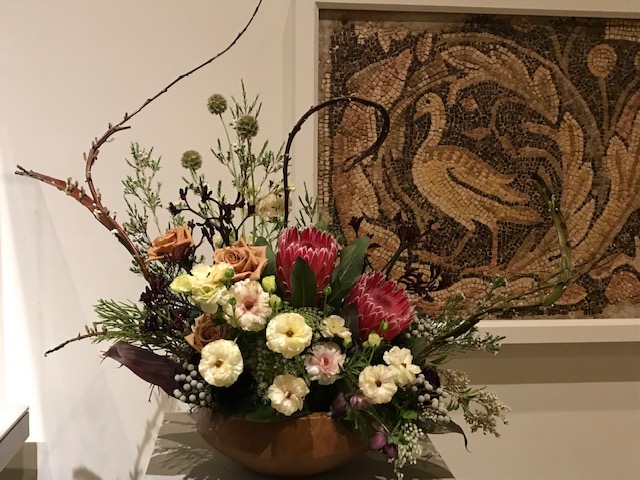
During the wet snowstorm last week I braved the elements and went to the Minneapolis Institute of Arts (Mia) for their Art in Bloom exhibit.
This was my first time to see this annual event of floral artistry. I think it works like this: a floral artist submits an idea using flowers and greenery that depicts different pieces of artwork…either sculpture, ceramics or paintings.
When awarded, the artist starts creating their floral masterpiece which is then set next to the artwork. A plaque conveys the artists name and how many times they have participated in this event.
I was excited to see this exhibit, and it was worth the snowy drive. It was the touch of spring I needed after this rather long winter.
It was the creativity of passionate artists using flowers.
It was the charm of being at the art institute.
It was the warmth being inside and occasionally walking past the vast windows of the Mia looking outside to see large snowflakes falling.
Snow fell outside while we enjoyed a touch of spring inside.
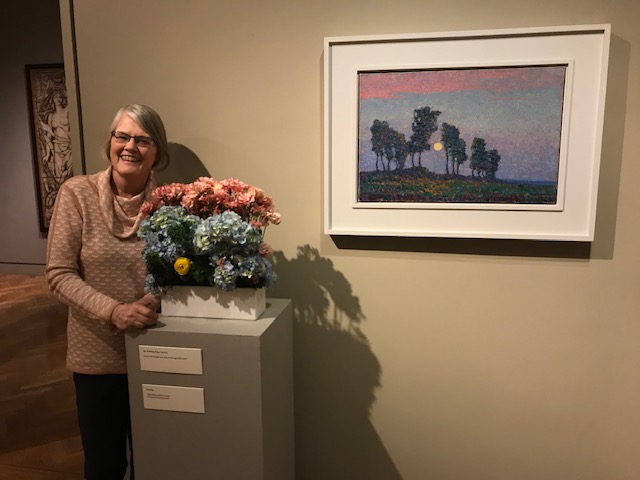
I’ve always be intrigued by the moon…I love how the moon is depicted in this floral arrangement.