After we left Kasson and our mini-history tour, we continued on our day trip to Oxbow Park in Olmstead County, near Byron, Minnesota. It is a surprisingly special place with a picnic area, a nature center, a zoo, a discovery playground, and camping facilities.
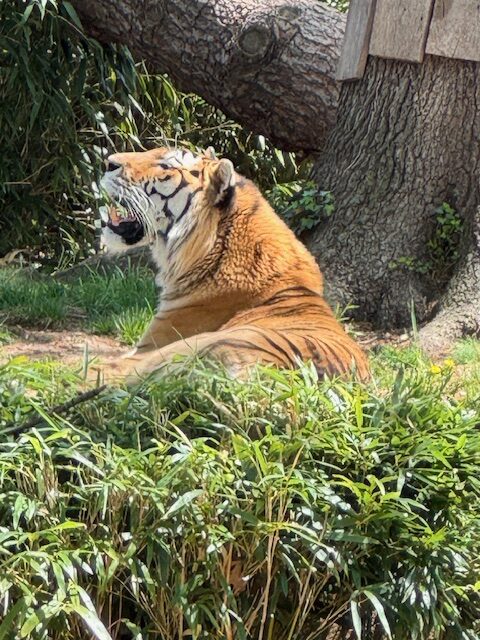
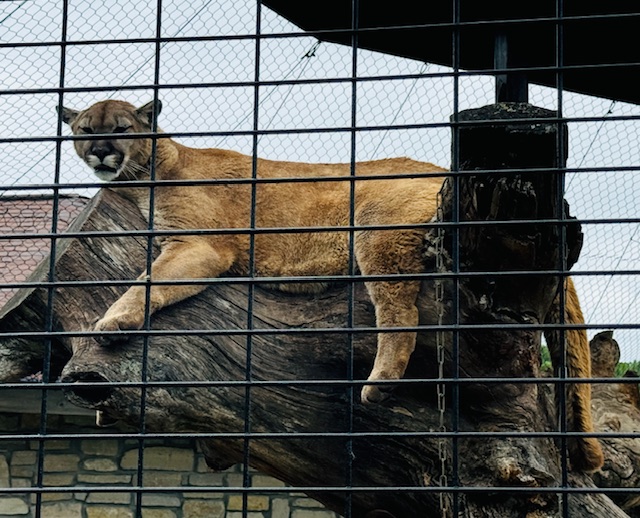
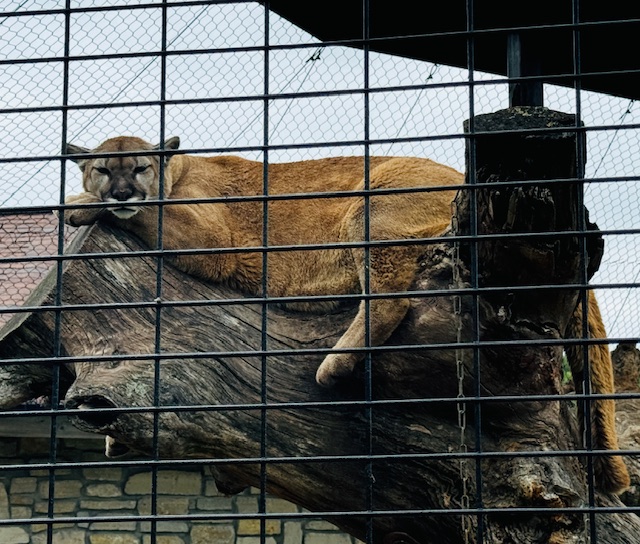
One relaxed cat!
The small, but amazing, Zollman Zoo is aligned with Oxbow Park and houses over 30 species of wild animals native to Minnesota. Many of the animals at this zoo have physical injuries so they cannot be released back into nature, and some other animals come from other zoo facilities that have surplus animals.
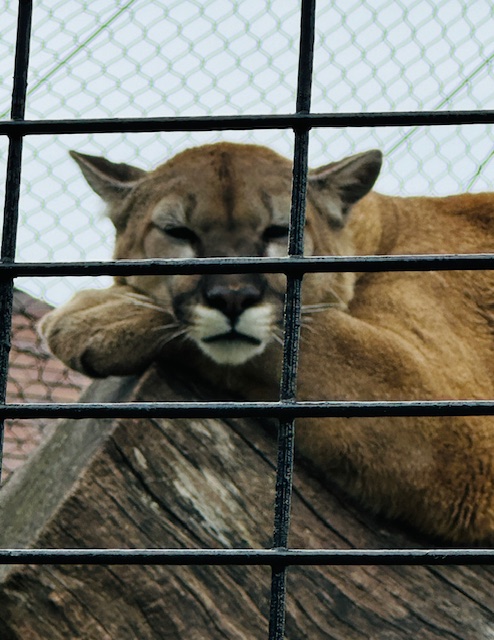
I told this guy I was going to take his picture…
My favorite was seeing the cougar looking very relaxed in a tree trunk, watching us from his perch. When I told him I was going to take his picture, he moved his big paw under his chin and posed for us!
I forgot to tell him to smile!
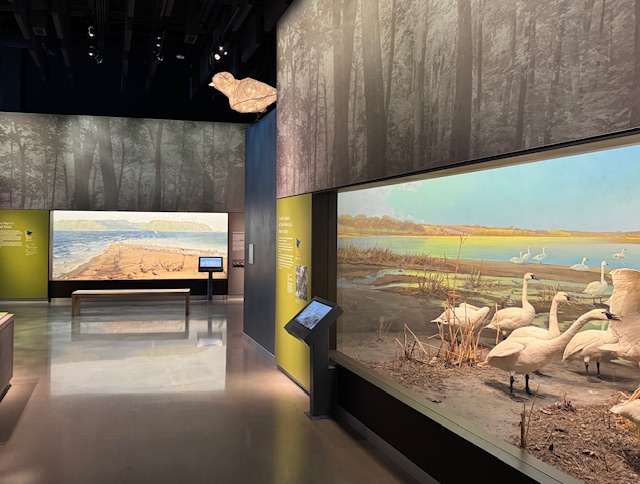
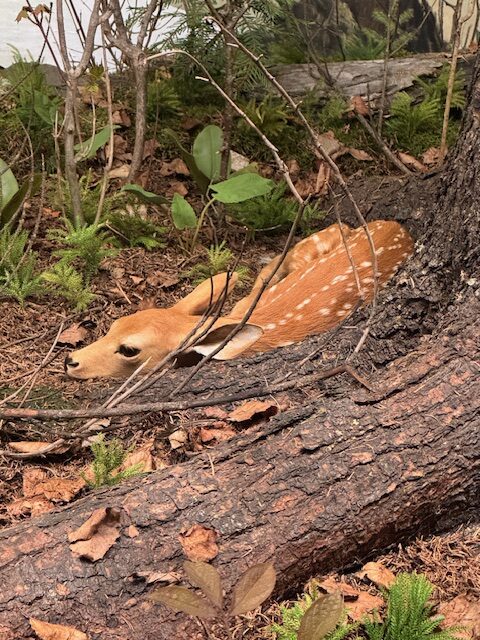
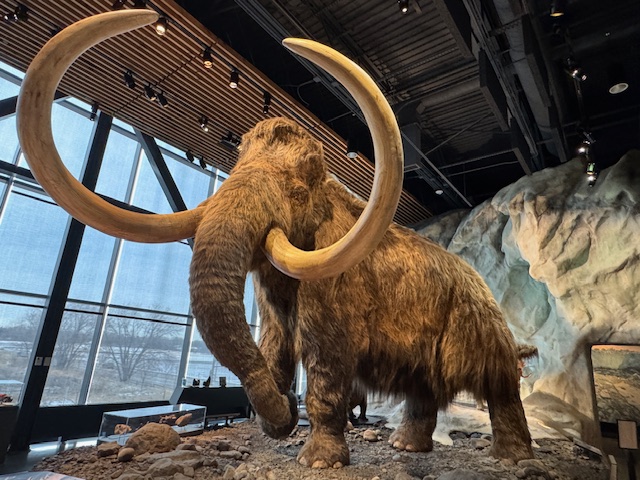
The nature center, also a part of Oxbow Park, is only a year old. It is spacious, modern and well done. A few more small critters are inside, as well as a lot of displays and information on nature.
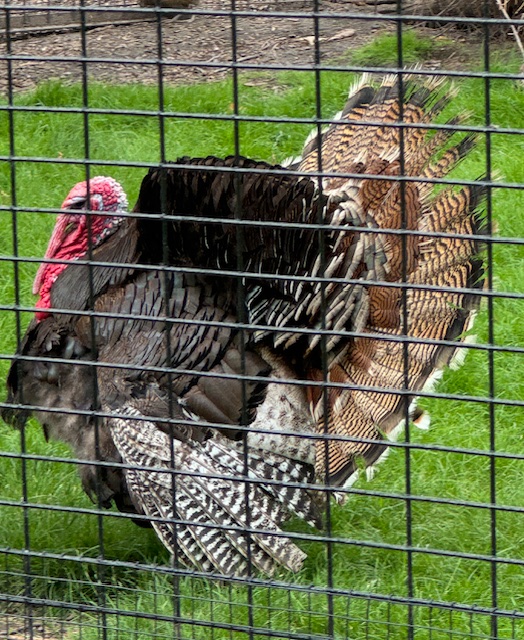
Gobble, gobble.
There was a bird watching station too. We sat for a few minutes and saw multiple hummingbirds drinking from a couple of feeders hanging outside the large windows.
This hidden gem is a place we hope to take our grandkids to, sometime this summer. Did I mention it is free? Donations accepted.
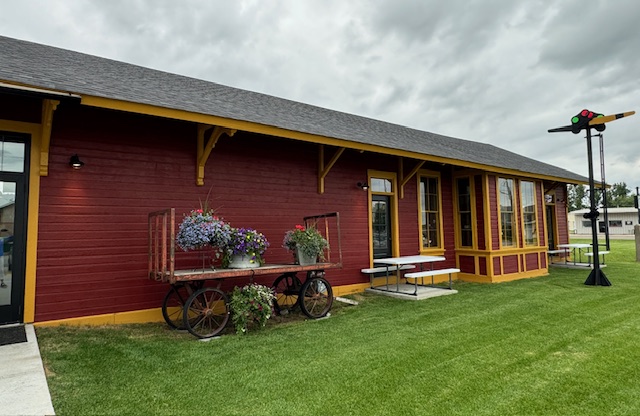
The Depot, Goodhue, MN.
And what day trip is complete without ice cream? Surprisingly, we had to search many small towns to find some. But we didn’t give up, and found The Depot, a renovated train station, in the small town of Goodhue. The new owner served delicious ice cream cones in a refurbished, old railway station, with friendly folk willing to give us a tour of the station’s renovation.
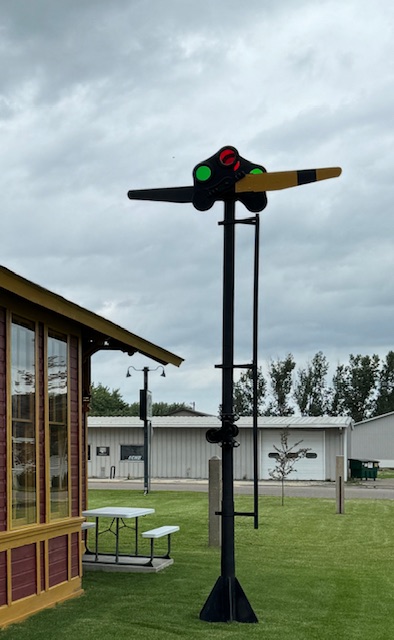
Old railway sign at The Depot.
Fun adventures and discovery awaits when you take the back roads of Minnesota.
A writing assignment was to answer this question… Has a stranger ever helped you at a difficult time? The answer is yes, and here’s the story.
Table Mountain in Cape Town, South Africa. photo vb
In 2015 we visited our son and his wife and our first grand-baby, Zoey, in Mozambique, Africa. We planned a side trip to Cape Town, South Africa as a chance to see another part of the continent. One of our most exciting, but challenging adventures there was to climb Table Mountain.
Photo by Robert Huczek on Unsplash (free internet photos)
Table Mountain is a beautiful sight overlooking Cape Town, and from a distance it looks like a table, thus the name.
A view of Cape Town off one side of Table Mountain. photo vb
Gary and I are used to hiking and have done a lot over the years. We’ve hiked some difficult terrains. Table Mountain ended up being one of the harder hikes I’ve done, but I didn’t know that when we started out. We donned our hiking boots and hats, and filled our water bottles and started up the steep path. There were several other hikers on this trail. It was hot, it was rocky, and it was pretty much straight up.
On our way up the rocky trail to the top of Table Mountain. photo gb
We were struggling. About two-thirds the way up there was an outcropping that provided a shady area, so we stopped to rest. A fit, young man came from behind us and noticed I was overheated. He asked if we had water. Yes, we did, thank you. Then he said to me, hold out your hat. I did as he said, and he poured HIS water into my hat and told me to tip it over my head. I did, and it felt so incredibly good to drench my hot self with the cool water.
After that, the young man continued on his merry way, and I was so grateful for his random act of kindness, and soon we continued our trek upward.
Note the cable car coming down from the station at the top of Table Mountain. photo vb
We rejoiced when we arrived at the top. We joined many folks enjoying the stunning vistas on this beautiful, sunny day (reaching the top by cable car or on foot). Then, as was our plan, we took the cable car down the mountain.
From the window of the rotating cable car, going down Table Mountain. photo vb
I was grateful for this young man’s random act of kindness that day on Table Mountain. What a delight to be treated so kindly… on a mountain trail… in a foreign country.
Outside of Santa Barbara, up the San Marcos Pass, there is a former stagecoach stop. The Cold Spring Tavern, built in 1868, brings one back in time to the Old West.
Cold Spring Tavern, opened in 1868.
A scenic drive led to this now popular restaurant where reservations are needed. We had lunch reservations set for 11:30 a.m., as soon as it opened.
The Cold Spring Tavern, a Wells Fargo stagecoach stop.
It sits all by itself on this old stagecoach route, on Stagecoach Road. We found parking in the rocky, rutty unpaved parking lot that held about ten cars. After the lot is full, cars line the streets for a long way…which was the case by the time we left.
The bar portion of Cold Spring Tavern.
I love eating outdoors, and this restaurant offered outdoor seating, but I thought it would be more of a unique experience to eat inside this original tavern. It had multiple, small rooms.
There are several rooms inside this tavern. We were seated in the room with the fireplace.
We were led to a room with a stone fireplace, and the fire was blazing. It was windy and cool outside so the fire felt good, and added much to the ambiance. We had the room to ourselves for a short while. We placed our order and sat back to relax in this unique and quiet setting. The food was tasty.
This outdoor space, in the back of the tavern, is used for receptions etc. The building in this picture is a road gang house, built for the Chinese road gang who built the toll road through the San Marcos Pass.
The sign for the Road Gang House.
We know friends from Northfield who were married at the Cold Spring Tavern, back in 1973. We thought of them while we were there.
The Cold Spring Tavern.
After lunch we drove another route home, through wine country and then back to Santa Barbara, along the Pacific Ocean.
In the past we have not usually acknowledged Mardi Gras, or Fat Tuesday, which is the day before Ash Wednesday, when Lent begins, but we did celebrate the occasion this year. When we arrived in Dunedin, where our friends now live in Florida, a Mardi Gras parade was scheduled for that evening.
The parade route was blocks from their house so we walked over to join the fun. Our friends had a few Mardi Gras parades “under their belt” because their daughter lives in New Orleans, so Sue dug out her box of goodies labeled “Mardi Gras” and we donned some extra embellishments before we headed out.
I did not know, but at Mardi Gras parades the MO (mode of operation) is to throw out sparkly beaded necklaces…and when you catch one (or miss it and pick it up off the street) you collect them around your neck. They are plentiful, and we had accumulated a lot by the end of the parade.
The parade was at night, which meant the floats and displays were all lit up with multi-colored lights. I’m a fan of color and I really enjoyed seeing the beautiful lighted processions. It was fun to catch the jewels too.
There was a very large turnout for this parade. The parade route ended at a city park where there were plenty of concessions stands and other forms of entertainment to participate in after the parade.
We experienced some colorful adventures on our trip. One being in the “American Sign Museum” in Cincinnati, Ohio.
After seeing some neon sign pictures recently, I became intrigued. I wondered if there was a neon sign museum anywhere in the U.S. I searched the internet and found a few…the largest being The Museum of Neon Art in Glendale, California. There was also The National Sign Museum in The Dalles, Oregon, The Neon Museum in Las Vegas, Nevada, American Sign Museum in Cincinnati, Ohio and The Lost Highway Museum (a private collection in Washington).
Note: 15 cent hamburgers!
I thought if our undetermined route takes us near Cincinnati, it might be possible to check out the American Sign Museum on our way home from our recent roadtrip…and we did. The museum is small (it’s hoping to expand) but it was full of fun signs (not all neon) and signage history.
We enjoyed our time looking at all the different types and styles of signs and we felt it was worth the stop. I would consider going to other sign museums, if there was an opportunity to do so.
I was impressed by all the figures neon signs could portray. They are truly works of art. Each one unique.
Color, color… wonderful, bright color.
Who knew it would be so interesting to see a collection of old signs, but it was!
It is great to know neon signs continue to be crafted.
On our way out of town, we drove past this old Dairy Queen with its own antique signage.
Color, color… so much color. This was one of two colorful adventures on this trip. Stay tuned for another one.
On our February road trip through the southeastern states, we met up with a lot of friends and family. We pre-planned, or made last minute plans, to connect with folks that either lived in the areas we visited, or they were visiting the same areas in the south where we were. Our two intended sightseeing destinations were Charleston, South Carolina and St. Augustine, Florida.
The historic Inn where we stayed in the carriage house, out back.
We stayed in a beautiful carriage house in the historic district of Charleston, South Carolina. It rained the first day we were there, but the inn provided umbrellas so we went on our merry way, walking around the city, and to the Charleston Museum which was very interesting.
Our lovely Bed & Breakfast room on the second floor of a restored carriage house in Charleston, South Carolina.
We toured a WWII aircraft carrier (the Yorktown) in Charleston which we found intriguing and worthwhile.
USS Yorktown is an aircraft carrier built during World War II for the United States Navy. It is located on Patriot’s Point in Charleston, SC.
We went on a horse-drawn carriage ride (on a nice, sunny day).
The Belgium-draft horse, Moultrie, took us for a ride on a carriage around town.
We walked along Rainbow Row (named for a series of thirteen colorful historic row houses in Charleston), and ate some great seafood.
Rainbow Row in Charleston, SC.
Charleston is nicknamed the holy city because of its number of church spires that dot its skyline.
St. Michael’s Church, Charleston, SC.
St. Michael’s is one of the churches with a steeple, built in the 1750’s. It is listed on the National Register of Historic Places. George Washington worshipped there one time, as did Robert E. Lee. It continues to have an active congregation today.
Inside St. Michael’s church.
It’s a stunning white church that stands out. It is gorgeous! During the revolutionary war, the steeple was painted black for disguise. For more of its colorful history click here: St. Michael’s Church.
A friend recommended I read the book Celia Garth prior to our visit to Charleston. It is a historical fiction novel by Gwen Bristow written in 1959. The narrative takes place in Charleston during the revolutionary war. The author provided me some orientation to the town, and a lot of its history. The story was fun to envision as we walked along the cobblestone streets.
An amazing mural painted on the side a a brick building, near the stables.
The beautiful, spacious front porch of the inn where we stayed in Charleston.
Charleston is s charming city.
St. Augustine, on the northeast coast of Florida, was an exciting place to visit too. It is the oldest city in the U.S., and is known for its Spanish colonial architecture. We enjoyed walking around this city, which is our preferred mode of transportation. The beautiful buildings and quaint shops and old city gate were all fun to see.
Flager College, established in 1968 in the former, luxury Ponce De Leon Hotel.
We toured the Castillo de San Marcos fort, a 17th-century Spanish stone fortress.
Castillo de San Marcos.
The drawbridge over the moat around the fort.
We climbed up 219 steps of the historic 1874 St. Augustine Lighthouse.
St. Augustine Lighthouse.
Looking up the spiral staircase in the lighthouse.
At the top of the lighthouse….
And we ate more great seafood.
We had a delicious dinner at this restaurant on the ocean in St. Augustine.
Our long shadows on an Atlantic ocean beach in St. Augustine.
Although I had not read a book about St. Augustine before our trip (it was referred to several times in Celia Garth), we throughly enjoyed our visit to the oldest city in the United States.
I liked this fountain. The masks that decorate this fountain was a gift to the City of St. Augustine (in 2005) by its sister city in Spain, the City of Avilés, birthplace of Pedro Menéndez, founder of St. Augustine in 1565.
We have arrived safely home from our 4,690 miles road trip, through eleven states in southeastern US. We saw a lot of beauty in nature, and beauty in the many friends and family we were able to visit. We are grateful all went well, and we had a great time!
There have been unusual weather patterns all across the country. It was warm here in Minnesota during February, with little snow fall. And it was cooler than normal in the southeast, where we were.
February 26, 2024 in Iowa.
In Iowa Monday night, February 26, it was 72* and we ate dinner outside on a restaurant patio.
February 28, 2024 in Minnesota.
But our welcome home present was a cold snap. As we drove closer to Northfield the next day, the temperature kept dropping. When we arrived home we unloaded our car in 25* temperatures. It also started snowing. Sigh. We woke up to 5*!
It is predicted to remain cold for one day and then the temperatures will start climbing back up again. What a roller coaster. I wonder what kind of weather March will bring?
While visiting with our friends near Clearwater, FL they thought we would like to visit the Seaside Seabird Sanctuary, and they were right.
We enjoyed seeing the beautiful coastal birds, which included owls, egrets, herons, and several other birds we see back in Minnesota.
We walked alongside this beautiful great egret.
Up close and personal with a great egret.
Bald eagles get around.
Although most of the birds in the sanctuary have been injured somehow, it was great to see them recovering and walking or flying around…some up close and personal.
A juvenile brown pelican.
A black-crowned night heron.
Many of the birds were in enclosures by themselves, or in large pens with multiple birds. Some were walking the grounds and others were flying freely.
One example of an enclosure for multiple birds.
White pelicans.
Of course, the risk is one may get bombed with a plop of bird poop. One such plop landed on our friend’s cell phone.
Two sandhill cranes.
The sandhill cranes were in an enclosed pen, but I was able to zoom in for a picture. I’ve only seen them in flight, or in a field before, so it was special to see them so close.
Some of the birds may be perfectly healthy, but they know where to find an easy, free meal. Part of the sanctuary is open to the seashore, along the intercoastal waterway.
An juvenile ibis.
A double-crested cormorant.
I’m grateful for the people who run this small, but intimate bird sanctuary that is free and open to the public (donations accepted). It’s a way to help the birds, and to introduce the birds to anyone who stops by.
Dipping our toes into the gulf waters.
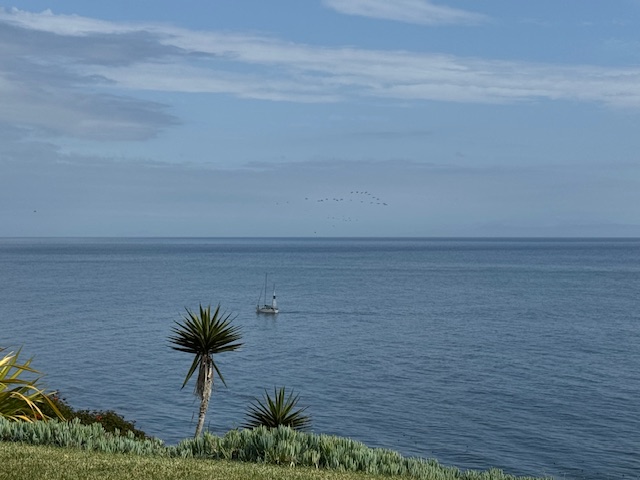
A serene photo of a sailboat on the beautiful water.
One of the attractions in Charleston, South Carolina is an old, oak tree named the Angel Oak Tree. I’m not sure how it got its name…maybe because of its huge canopy of overarching branches offering protection. It is a Southern live oak, which is different than your “ordinary oak” tree.
Photo of a promotional video from the breakfast room.
“The Southern live oak (Quercus virginiana), also known simply as the live oak, gets its name from the fact that, unlike other oaks, it doesn’t lose its leaves in the autumn. Live oaks are native to the Southeastern coast of the United States.”*
The massive trunk of the Angel Oak tree.
We like trees and decided to drive the extra miles out of town, to visit this majestic tree. It did not disappoint. Surprisingly, it is down a rutty, dirt road.
Warning signs were posted many places along the chainlink fence surrounding the tree.
We knew we had arrived when we saw a high, chainlink fence outlining the circumference of the tree, with signs saying this property is protected and patrolled. We noticed the surveillance cameras too. The area is free and open to the public during the day, but closed and gated at night.
Gary standing near the Angel Oak tree.
This is all good. We contrasted this to the Sycamore Gap tree next to Hadrian’s Wall where we hiked last fall, in England. That sycamore tree stood tall and majestic also, and was 200-300 years old, standing alone in the gap, for anyone to enjoy. A national treasure, for Great Britian. Unfortunately, two weeks after we sat under that beautiful Sycamore tree, vandals came and cut it down! Hopefully that will not happen to the Angel Oak Tree in South Carolina.
Large branches touching the ground.
Looking out from the trunk at this branch on the ground.
The Angel Oak tree is a national treasure. It is 300-400 years old…some estimate even older. They say the tree is 65 feet high with a trunk circumference of 25.5 feet, shading an area of 17,000 square feet. Of course, I couldn’t capture the whole tree in one photo…but I did take several photos.
The beautiful red cardinal singing for us.
The Angel Oak tree was worth the extra effort to find. A cardinal serenaded us from a different tree, but he added extra joy to our experience. A new baby tree has been sprouted from an acorn from the Angel Oak tree. It is three years old and grows in a pot next to the trunk, under the protecting branches of its mama.
This Baby Angel was planted in 2018 from an acorn fallen from the Angel Oak Tree.
Me and the big tree and the baby tree.
A magnificent stately tree.
Think of all this tree has lived through. Ah, the stories it could tell.
I never have given much thought to farm animals before I started feeding the amazing creatures at the farm where I help out about once a month. Often when I help out at this local farm, I tag along with their primary caretaker so I can keep current on the method to remember which animal gets what, and how much. Then, when the caretaker wants time away, I am solely responsible to feed the animals and get it right.
Farm quilt from the National Quilt Museum. January 2022
I agreed to help out this week long before I knew it would be so cold outside. I started worrying about how the animals survive during these days of frigid, subzero temperatures. I didn’t realize how much I have let these animals into my heart and care a lot about their welfare.
My favorites…the two horses, in May 2023. I didn’t take any photos of the animals on the frigid day in January.
I looked up how horses survive and I learned that horses grow a “new, longer hair coat. These winter hairs stand up, trapping tiny air pockets between them. The effect is like that of a thick, down-filled comforter with tremendous insulating quality.”*
“The boys.” Photo taken March 2022.
Then I looked up how donkeys survive in the cold temps and it said donkeys should have a suitable shelter, a structure of at least three sides, and it should be free from draughts, and be waterproof.*
One of the two goats. I have a hard time telling them apart. Photo from March 2022.
Finally, I looked up goats. For goats, they need a winter shelter that is dry and waterproof and out of the wind. Inside this shelter, the goats will stay warm even during the coldest weather.*
And that is how it played out the day I went to feed the animals on my own. The temperature managed to crawl to one degree above zero, but the windchill was 19 degrees below zero. Gary drove me out to the farm and provided a warming station (the truck) for me to tuck into between chores.
Beautiful Abbey. Photo taken July 2023.
When we arrived I got out of our truck and was greeted by the farm dog, a cute little guy. He ran up to welcome me, and I gave him lots of pats and rubs, and he in turn gave me lots of excited tail wags.
Then I looked in on the cats and they were safely tucked inside an out building…I added food to their bowls and checked their water. I made sure the cat door was locked for the night.
Best buddies, and brothers. Photo taken July 2023.
When I arrived at the horse and donkey pens, sure enough, the horses were standing outside waiting for their dinner, and “the boys” (two donkeys who are brothers) were staying warm in their three-sided shelter. I petted them all, talked to them while parceling out their hay, and checked to make sure their water hadn’t frozen over.
Anita. Photo taken July 2023.
At the goat pen, the two goats were also waiting for me in their shelter. I filled their food dishes and quickly placed them apart from each other before getting in the middle of the two hungry goats.
Last, but not least, the chickens were in the chicken coop, waiting for supper.
I really enjoy this little gig…I have always loved animals, but never had the chance to be around many farm animals. I’m grateful for this opportunity to care for them and to get to know them by name, and even talk with them!
*source of info: Wikipedia
P.S. I understand that this is fun for me because I do it occasionally. I pray for the caretaker who feeds and cares for the animals morning and evening, day in and day out, and on hot, sunny days and gray, subzero days!