I’ve mentioned this before, but I really am impressed with our Northfield Public Library!
I arrived at the library this morning and it was buzzing with lots of folks, including a lot of children in the children’s section. It was wonderful to see.
First, I went to pick up the book I had requested. A great system…you request the book, the librarians find the book and set it aside, you walk in and pick up the book off the hold shelf, and self-check out. Slick.
Then, I went upstairs to ask questions of the librarian and she took her time showing me the new system. I also had a question about WORD docs and she was able to help me with that too. I thanked her and told her how much I appreciated her help and how much I like our library!
On my way out I ran into a friend I haven’t seen for a while, and we were able to chat a bit.
A beautiful old catholic church (1834) in the city: The Cathedral of Angra do Heroísmo.
I really liked this wooden sculpture of Jesus the carpenter we saw in a church. I’ve never seen Jesus portrayed as a carpenter in a sculpture form before.
A landscape view of San Miguel, the green isle.
An inviting path to the sea.
Yummy gelato…
Yummy fruits and vegetables!
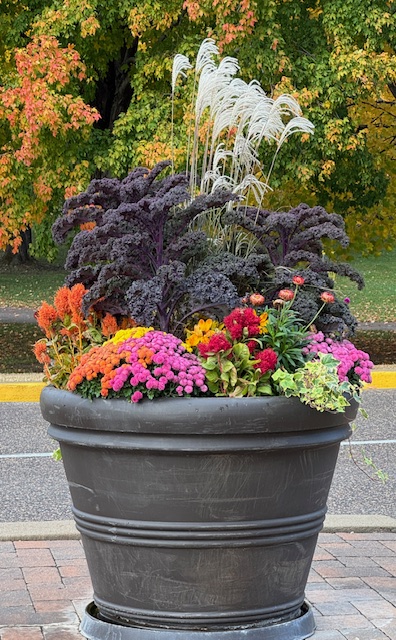
A humongous pot of pretty petunias.
There were several types of roosters “strutting their stuff”, on all the islands.
These two parrots, in an enclosed area in a park, were fun to watch.
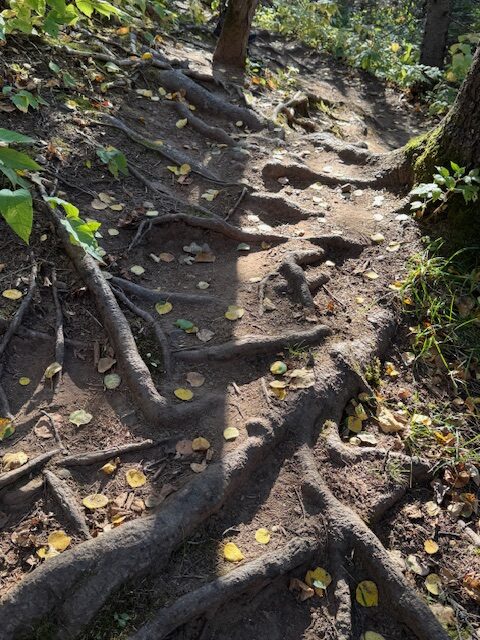
I like this photo of the exposed tree roots, growing down, down, down into the earth.
This tree was called the elephant foot…must be a nickname! 😉
And then there were so many flowers…these photos capture a few unusual ones…
I loved the way the twilight reflected in these windows.
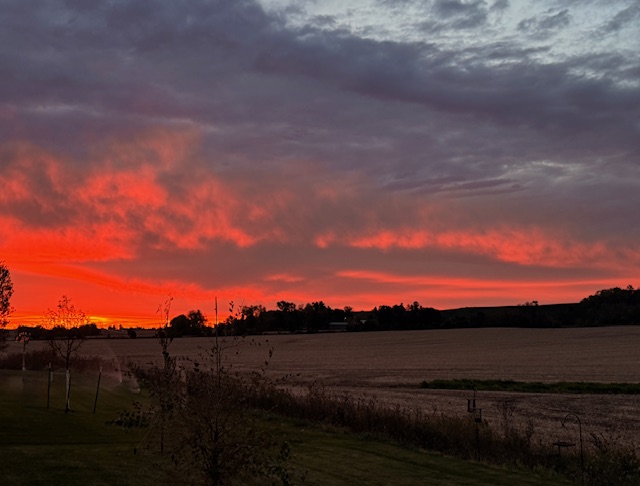
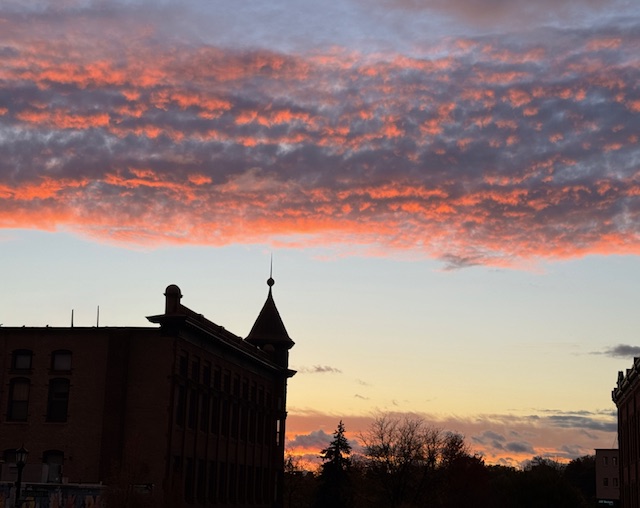
As we were driving home the other night after a storm we turned the corner and there was this dramatic scene in the sky. Cloud art…as my friend has titled my photos of interesting cloud formations.
For our last dinner together in Funchal on Madeira Island, we walked to the Mozart Restaurant, located on Rua de Santa Maria. This is one of the oldest streets in Funchal.
On our way down Rua de Santa Maria to the Mozart Restaurant.
It is a pedestrian-friendly cobblestone street, with some car traffic. It is lined with small restaurants, cafes and a small art gallery or two. It is also known for its painted doors.
The Painted Doors Project began in 2010 with the idea of revitalizing the Zona Velha (Old Town) area, specifically Rua de Santa Maria.
It invited artists to transform old doors into unique works of art. The project was successful and continues today. It features a diverse range of artistic styles on painted doors, creating a vibrant outdoor art gallery.
This public art form continues today, so the street art is ever-changing.
It seems to me that public art does promote community, and I personally, always like to see art in the public.
These photos are a sampling of the many painted doors along Rua de Santa Maria.
It was an entertaining walk to one of the quaint restaurants along this historical street.
The last island we visited on our two-week trip to “islands in the middle of the Atlantic Ocean” was Madeira, a separate archipelago consisting of four islands. Madeira island is southeast of the Azores and about 600 miles west of mainland Portugal.
The view over the infinity pool looking towards the Atlantic Ocean, on the roof top of our hotel in Funchal.
Funchal, the capital of Madeira, where we stayed in a lovely boutique hotel with a rooftop pool and fabulous view of the city and ocean, was winding down from a Flower Festival on the island…beautiful carpets made of flowers along the sidewalks, and stunning flower arrangements everywhere.
A carpet of flowers found on sidewalks and in hotel lobbies.
It was the last days of the festival.
One of many stunning flower arrangements.
We went on a grand driving tour to: Camara de Lobos, a fishing Village, Cabo Girão, a striking overlook of the sea (the cliff is 589 meters above sea level or 1,932 feet), and Serrado da Eira, a picturesque mountainous region of Madeira.
Interior views on Madeira Island.
Serrado da Eira Viewpoint.
Looking straight down from cliff overlook, 589 meters (1,932 feet) above sea level. photo gb
Another view looking down from the high cliff to the shoreline. photo gb
We went to a rum factory and a farmer’s market, walked down a historic street with unique painted doors, and went on a cetaceans-watching tour. We didn’t see any whales but we did see dolphins and a beautiful coastline. (I have no photos from our boat tour because I do not bring my camera/phone near any bodies of water after having lost electronics in lakes a couple of times!)
Camara de Lobos fishing village.
We ate at several fantastic restaurants on Madeira Island. A huge European breakfast buffet was offered at all our hotels, on all the islands, each morning. Lunch and dinners were a mixture of eating as a group in small, local restaurants, or visiting a quaint sidewalk café when dinner was “on our own.”
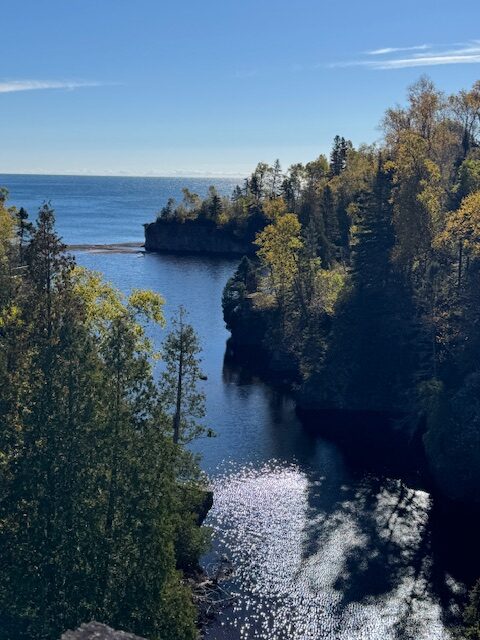
We ate lunch at Quinta do Furão, part of this lovely hotel complex.
In Madeira we ate together at several special restaurants but three stand out…lunch at Quinta do Furão on the outdoor patio with lovely views of the ocean,
The lunch view. photo gb
il Vildali, a Mediterranean Cuisine restaurant that was eloquently set for us at a huge table with luxury tablecloth and candelabras,
il Vivaldi Mediterranean Cuisine Restaurant.
and on our last night together we ate at Mozart Restaurant; with a fun wait staff and interesting bathrooms.
The Mozart restaurant was on the Rua de Santa Maria, one of the oldest streets in Madeira. It is a pedestrian-friendly cobblestone street, with some car traffic. It is lined with small restaurants, cafes and a small art gallery or two. It is also known for its painted doors.
Funny to say, but bathrooms can be very interesting. I have always liked to check out bathrooms in different places, but in the Mozart Restaurant we all checked out the bathrooms. The room was all mirrors, including floors and ceilings. It was unique!
The room of mirrors…the separate room with the toilet was the same; all mirrors.
It is here where we had to say good-bye to our new friends whom we shared so many wonderful adventures together over two weeks. We were so happy to have had our paths cross with these fine folks. It was sad to bid farewell.
These peace lilies were growing wild all over the islands.
São Miguel Island is the poster child for the Azores. When you see brochures for the Azores, you see a picture of a caldera on San Miguel Island. A caldera is a large, bowl-shaped depression formed by the inner collapse of a volcano’s summit. It’s distinct from a crater, which is a much smaller, depression typically formed by outward explosion of material during an eruption.
This is photo of a photo in an ad promoting the Azores, taken on Såo Miguel.
This is our photo of the famous caldera the day we saw it…still beautiful even with the cloud cover. photo gb
One of the jeeps in our caravan.
For this discovery adventure with OAT, we were divided into small groups, and rode over rough terrain in jeeps to the western part of the island to see this caldera. Although it was overcast, we enjoyed seeing the stunning landscapes along the way.
Mata Jardim José do Canto – one of the botanical gardens on São Miguel.
Also, on this island we went to a botanical garden (Mata Jardim José do Canto) with a thermal pool. The hot springs look muddy, but its minerals in the water that make it look that way.
The thermal pool, in the botanical garden. photo gb
We were told to bring an old swimsuit since they would get stained from the water. It felt good to be in the hot pools.
Inside one of the greenhouses on the pineapple plantation. photo gb
We visited a tea plantation (Henrique -our tour guide- worked there when he was younger), and we visited a pineapple plantation.
Cascada (Portuguese) = Cascade (English).
Full and lush and green. photo gb
We stopped at Ribeira dos Caldeirões Park, with beautiful waterfalls and more lush, green plants…São Miguel…aptly nicknamed the green island…Ihla Verde.
The green island.
On this island we experienced a local dairy farm, milking about 25 cows. It is run by a Gena and João, a couple dedicated to a small, self-sufficent, organic farming operation.
Gena and João, in the barn on their dairy farm. photo gb
As we stood out in the field with the dairy cows, one cow in particular kept nudging everyone. Later, back in the barn (which was connected to electricity just last year) we gathered around the milking stalls and took turns milking a cow by hand.
Gary milking a cow by hand.
Henrique at the head of the farm table. photo by Gena
Back in the soon-to-be remodeled stone outbuilding, a wonderful dinner was set for us and we ate their home-grown food. This type of farming reminded Gary of his grandparent’s farm…with their old-fashioned ways of doing things.
At the grocery store, with our assignments.
Earlier that morning Henrique divided us into groups and gave us some Euros and a short shopping list, in Portuguese, to buy a few items to bring to dinner at the farm later that day.
The local grocery store. (Decked out for the upcoming festival. Most store fronts are decorated for the special festival.)
He showed us which store to shop for local fare, and asked us to try and not speak English. That was a fun outing. We succeeded in finding the food…not sure about the not speaking English.
The lighting ceremony on the plaza in Ponta Delgado, on São Miguel Island. The ceremony marks the beginning of the festival “Festas do Senhor Santo Cristo dos Milagres” (Lord Holy Christ of the Miracles).
On our last night on this island there was an opening ceremony for a huge annual religious festival. We were leaving the island the next day, but were able to walk to the main plaza after dinner to watch the lighting ceremony. It was a festive atmosphere and a pretty sight to see.
As I was walking in the cobblestone plaza, I tripped and fell into two women in the crowd. They kept me from falling…I said “Obrigada (thank you)”, and they replied, “that’s what we’re here for – to hold each other up!” Another fun interaction with strangers!
A very small village along the coast of São Miguel. photo gb
We enjoyed the natural wonders and beauty of São Miguel.
We arrived on the island of Terceira a day before our official tour with OAT began.
Overlooking the city of Angra do Heroismo on Terceira.
A lilac-color hydrangea in bloom.
We wanted to acclimate our body clocks, plus we wanted to get a hike in with our friends we travel with.
A stop along our hike up Mount Brasil.
We had a good weather, a sunny day and an interesting hike up Mount Brasil.
An inviting trail on Mount Brasil.
Looking over a caldera, to the Atlantic Ocean.
Looking to the ocean from Mount Brasil.
The next day we met our OAT tour group. OAT promotes discoveries and experiences, so they bring the groups to small, local businesses and out of the way places, and even make unscheduled stops. One day we stopped at a farmer’s market and a fishing dock to talk with a local fisherman, neither one on the schedule for that day.
At the fishing dock, a local fisherman shows us the bait that has been assembled for the next round of fishing. These are fish heads/parts secured on a hook for a fishing line.
A few of the many experiences on the island of Terceira was a small winery tour, an organic coffee/banana plantation tour, seeing the dramatic tide pools, and having dinner with a local family. All were remarkable in their own way.
Buildings for the winery built from lava rock.
Several volcanic rock walls create an amazing vineyard.
The Materramenta Winery was interesting. The vineyards were enclosed, and divided, by volcanic rock walls making it picturesque,
Some grapevines were planted in rows in a small area.
Other vines were planted in deep volcanic rock holes – a special planting method. photo gb
An interesting vineyard.
plus adding a unique and great flavor to the wines apparently.
The olive tree in the corner is to detract birds from eating the grapes. photo gb
The lava rock walls were strategically put together to allow air flow.
After a tour of the vineyard, we were invited into a tasting room with a long, welcoming table.
Setting for our wine tasting at this small winery.
The coffee/banana plantation was so different from the winery, yet beautiful in a different way. It was very lush.
José, the owner of an organic coffee and banana plantation gives us a tour.
A bucket full of organic coffee beans.
José, has expanded his small business into eco lodging and built a few small camping cabins in the midst of the plantation.
A nice camping cabin on the coffee plantation, complete with indoor plumbing!
The a-line cabins were inviting, and are creating more income for this family.
One of my favorite pictures at one of my favorite spots on our trip.
One of my two favorite activities on Terceira was going to the Biscoitos tide pools to watch the waves crash over the volcanic boulders along the shore.
Making a big splash!
Mini waterfalls created by waves crashing in.
It was mesmerizing. A fellow traveler commented with waterfalls the water flows down, but along the shore when the waves hit the rocks the water bursts up into the air.
Beautiful colorful water.
Aqua colored water coming in.
Biscoitos tide pools.
Another favorite activity was a local home visit. One evening our big group was divided into three small groups and folks on the island invited us into their houses for a home-cooked dinner, and for a peek at how the islanders live. It was wonderful.
We were invited into this beautiful home for dinner. photo gb
Due to different circumstances, our host was on his own with all six of us, but his wife had the meal mostly prepared and he pulled it off flawlessly. He was a great host and his 17-year-old and 6-year-old joined us near the end of dinner. We had a delightful evening.
Roger, our home host, adding the final touches to dessert.
And that was not all (that we did on Terceira)…But it is enough…(for now).
We just returned from an adventure to the Azores, an archipelago in the Atlantic Ocean, with an added hop to the island of Madeira, all governed by Portugal.
The first morning after we arrived on the island of Terceira, one of the nine islands in the Azores archipelago, I greeted a woman in the hallway of our hotel and she enthusiastically replied, “We’re on a small island in the middle of the Atlantic Ocean!” And off we went on our separate ways. But, those twelve words became my mantra throughout the trip. Many times I would remind myself, and those around me, by saying out loud, “we’re on an island in the middle of the Atlantic Ocean!” It was kind of crazy, but very beautiful, and definitely wonderful.
Angra do Heroísmo, the capitol city of Terceira, with Mt. Brazil in the background.
Our adventures started in Terceira (nicknamed the lilac island because of the many lilac-colored hydrangeas there – which only a few were in bloom at this time). After five nights we flew to São Miguel (the green island) our second of the nine islands in the archipelago, and ended up in Madeira, an island between the Azores and Portugal.
The harbor at Angra do Heroísmo, Terceira.
We were traveling with a tour group (Overseas Adventure Travel) for the first time. There were 16 of us in the group, all from different areas of the US. The tour guide was a local man who lived on the island of São Miguel. He was knowledgeable, very personable, and took good care of us. He spoke great English with a wonderful accent. We were together with these same folks for twelve days. We traveled well together. Our group had some very interesting people, and it was fun to get to know them. Everyone has a story.
Henrique, our wonderful OAT tour guide, from São Miguel.
I’m finding the longer one is on tour the more pictures one takes… and then all those photos have to be gone through. It is a time-consuming job, but a fun one. I will be share more stories and photos in the coming weeks.
We moved into our new home in December. All winter I looked forward to seeing a tractor in the field behind us this spring, preparing the field for planting.
I first saw the tractor in back of our house at 7:40 pm on Monday evening.
We’ve been doing some traveling and I thought maybe I might miss it this year, but last night the tractor came through, tilling the soil. He started late in the day, and kept going into the night with his lights on, but he didn’t finish the job.
Up close.
The darker soil is two swaths from the tractor.It was fun to see the lights on the tractor, while he worked in the field at night, 8:55 pm.
He was back the next morning to finish the tilling.
8:37 am on Tuesday.
It was interesting to see the wide swath of land that was tilled in one run. And I was amazed at how fast the tractor traveled. I had fun watching it while trying to take some pictures. The ground is dry and the tilling produced a lot of dust. It was hard to see the tractor through the dust at times.
Creating a lot of dust!
We’ll wait to see what is planted…there has been corn in the field the past two years. Maybe they’ll alternate this year, and plant soy beans.
The tractor pulling a seed planter. 3:30 pm Tuesday.
To my delight, he came back in the afternoon to plant. I wonder what is in those yellow seed box containers?
Like the tiller, the planter is a huge piece of equipment.
And then… there were two! It keeps getting more and more interesting. I did not grow up on a farm and so I have really enjoyed seeing this basic, yet key principle, of farming up close.
It just keeps getting better…3:55 pm Tuesday…there were two tractors in the same field.
I did some tilling of my own and planted zinnia seeds along the field in our back yard…hopefully the zinnias will come up too.